7 Higher orders

So far we have only calculated observables at the first order in perturbation theory. This is usually fine to get a rough idea of the cross section but especially in QCD where αs0.1\alpha_{s}\sim 0.1, higher-order corrections can be very large (up to 100%). If we want to do any kind of precision measurement, either at the LHC or elsewhere like the anomalous magnetic moments from the abstract, we need more precision. Luckily, we have the tools to do this by simply drawing more complicated Feynman diagrams.

Consider for example the first correction to the ϕ\phi propagator in ϕ4\phi^{4} (cf. (194))

Ω|T{ϕ(x)ϕ(y)}|Ω\displaystyle\langle{\Omega}|T\{\phi(x)\phi(y)\}|{\Omega}\rangle =
A lone propagator
+
A propagator with a tadpole
+𝒪(λ2)
\displaystyle=\includegraphics{bmlimages/notes-151.svg}\bml@image@depth{151}% \bmlDescription{A lone propagator}+\includegraphics{bmlimages/notes-152.svg}% \bml@image@depth{152}\bmlDescription{A propagator with a tadpole}+\mathcal{O}(% \lambda^{2})
(408)
=1p2m2+iϵ+1p2m2+iϵλ2d4k(2π)4ik2m2+iϵ1p2m2+iϵ+𝒪(λ2).\displaystyle=\frac{1}{p^{2}-m^{2}+i\epsilon}+\frac{1}{p^{2}-m^{2}+i\epsilon}% \frac{\lambda}{2}\int\frac{{\rm d}^{4}k}{(2\pi)^{4}}\frac{i}{k^{2}-m^{2}+i% \epsilon}\frac{1}{p^{2}-m^{2}+i\epsilon}+\mathcal{O}(\lambda^{2})\,. (409)

Let us focus on the integral. To calculate it, we should first try to replace the integral over the Minkowskian momentum kk into a Euclidean one. We currently have k2=(k0)2k2k^{2}=(k^{0})^{2}-\vec{k}^{2}. If we could replace k0ik4k^{0}\to ik^{4}, we have instead

k2\displaystyle k^{2} =(k0)2k2(k4)2k2kE2,\displaystyle=(k^{0})^{2}-\vec{k}^{2}\to-(k^{4})^{2}-\vec{k}^{2}\equiv-k_{E}^{% 2}\,, (410)
d4k\displaystyle{\rm d}^{4}k =dk0d3kid4kE.\displaystyle={\rm d}k^{0}{\rm d}^{3}\vec{k}\to i{\rm d}^{4}k_{E}\,. (411)

kEk_{E} is now a normal Euclidean vector that integrate normally. By looking at the integration counter shown in Figure 6, we can see that this does not change the integral. The poles of the k0k^{0} integration are at k0=±k2+m2iϵk^{0}=\pm\sqrt{\vec{k}^{2}+m^{2}}\mp i\epsilon in the top-left and lower-right quadrant. This means the integral over the whole contour vanishes

0=dk0=(+ii+arcs).\displaystyle 0=\oint{\rm d}k^{0}=\Bigg{(}\int_{-\infty}^{\infty}+\int_{-i% \infty}^{i\infty}+\text{arcs}\Bigg{)}\,. (412)

Assuming the arcs vanish, we can write

d4k(2π)41k2m2+iϵ=id4kE(2π)41kE2+m2.\displaystyle\int\frac{{\rm d}^{4}k}{(2\pi)^{4}}\frac{1}{k^{2}-m^{2}+i\epsilon% }=-i\int\frac{{\rm d}^{4}k_{E}}{(2\pi)^{4}}\frac{1}{k_{E}^{2}+m^{2}}\,. (413)

This procedure is called Wick rotation.
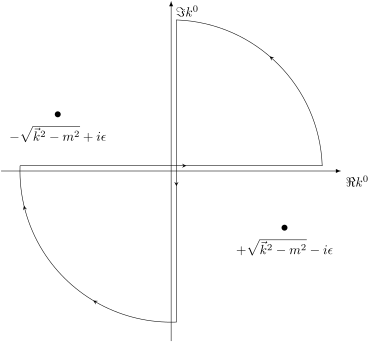
The complex k^0 plane with poles at -\sqrt{k^2-m^2}+i ϵand +\sqrt{k^2-m^2}-i ϵ. The integration contour follows the real axis until it arcs to +i∞, follows the imaginary axis down, and arcs back to -∞where it closes
Figure 6: The contour of the Wick rotation

Before we start calculating, let us just look at the integral. If kmk\gg m, the integral will scale like kE4/kE2kE2k_{E}^{4}/k_{E}^{2}\sim k_{E}^{2}\to\infty, i.e. the integral is divergent! What does this mean for the whole concept of QFT? If higher-order terms can diverge, the λ\lambda suppression does not really matter and we loose all predictive power.

Before we continue, we should introduce one more item of terminology. We already know how to classify by connected vs. disconnected and by amputated vs. non-amputated. Now we introduce one-particle irreducible (1PI) diagrams that cannot by split into two diagrams by cutting a single line. For an example of the three categorisation, see Table 7.

category example counter-example
connected

Some example diagrams that are connected or unconnect, amputated or non-amputated,

Some example diagrams that are connected or unconnect, amputated or non-amputated,

Some example diagrams that are connected or unconnect, amputated or non-amputated,
amputated

Some example diagrams that are connected or unconnect, amputated or non-amputated,

Some example diagrams that are connected or unconnect, amputated or non-amputated,
1PI

Some example diagrams that are connected or unconnect, amputated or non-amputated,

Some example diagrams that are connected or unconnect, amputated or non-amputated,
Figure 7: Some example diagrams that are connected or unconnect, amputated or non-amputated, 1PI or non-1PI.

7.1 Regularisation

To fix this problem, we first need to make it manifest. This means we need to introduce some way of parametrising the problem through a process called regularisation that we have encountered before. In the following section we will concurrently develop two regularisation techniques: cut-off regularisation and dimensional regularisation (dimreg). The former is conceptually easier to understand but very difficult to implement in practice. The latter may sound a bit more abstract and esoteric but is how almost all modern calculations are carried out.

Additionally to Ω|T{ϕ(x)ϕ(y)}|Ω\langle{\Omega}|T\{\phi(x)\phi(y)\}|{\Omega}\rangle, we will also calculate the four-point function

p4p3|T|p2p1|1L,p=0=
Two particles coming in, scattering into a bubble-shaped loop, scattering again and leaving
+permutations
=(i)(iλ)232d4k(2π)4i2(k2m2+iϵ)2
\displaystyle\langle{p_{4}p_{3}}|T|{p_{2}p_{1}}\rangle\Big{|}_{1L,p=0}=% \includegraphics{bmlimages/notes-161.svg}\bml@image@depth{161}\bmlDescription{% Two particles coming in, scattering into a bubble-shaped loop, scattering % again and leaving}+\text{permutations}=(-i)(-i\lambda)^{2}\frac{3}{2}\int\frac% {{\rm d}^{4}k}{(2\pi)^{4}}\frac{i^{2}}{(k^{2}-m^{2}+i\epsilon)^{2}}
(414)

7.1.1 Cut-off regularisation

Since our problem is due to kk being very large, let us just truncate the integral at some large value Λ\Lambda. We can now simply write

Ω|T{ϕ(x)ϕ(y)}|Ω|1L=λ32π4Λ1kE2+m2=λ16π20Λdkk3k2+m2=λ32π2(Λ2m2logm2+Λ2m2).\displaystyle\langle{\Omega}|T\{\phi(x)\phi(y)\}|{\Omega}\rangle\Big{|}_{1L}=% \frac{-\lambda}{32\pi^{4}}\int_{\Lambda}\frac{1}{k_{E}^{2}+m^{2}}=\frac{-% \lambda}{16\pi^{2}}\int_{0}^{\Lambda}{\rm d}k\frac{k^{3}}{k^{2}+m^{2}}=\frac{-% \lambda}{32\pi^{2}}\bigg{(}\Lambda^{2}-m^{2}\log\frac{m^{2}+\Lambda^{2}}{m^{2}% }\bigg{)}\,. (415)

Expanding this in Λ2/m2\Lambda^{2}/m^{2}, we find

Ω|T{ϕ(x)ϕ(y)}|Ω|1L=m2λ32π2(Λ2m2logΛ2m2)+𝒪((Λ/m)0).\displaystyle\langle{\Omega}|T\{\phi(x)\phi(y)\}|{\Omega}\rangle\Big{|}_{1L}=-% \frac{m^{2}\lambda}{32\pi^{2}}\bigg{(}\frac{\Lambda^{2}}{m^{2}}-\log\frac{% \Lambda^{2}}{m^{2}}\bigg{)}+\mathcal{O}\big{(}(\Lambda/m)^{0}\big{)}\,. (416)

This does not solve the problem but makes it explicit enough that we can talk about it.

Suggested Exercise

Calculate the other process to show that

p4p3|T|p2p1|1L,p=0=3λ232π2logΛ2m2\displaystyle\langle{p_{4}p_{3}}|T|{p_{2}p_{1}}\rangle\Big{|}_{1L,p=0}=\frac{3% \lambda^{2}}{32\pi^{2}}\log\frac{\Lambda^{2}}{m^{2}} (417)

7.1.2 Dimensional regularisation

A big downside of cut-off regularisation is that it breaks Lorentz invariance until we set Λ\Lambda\to\infty. Combined with the fact that it makes integrals more complicated, it is no surprise that it is rarely used in practical calculations. Instead, we shift the spacetime dimension away from four, i.e. we work in d=42ϵd=4-2\epsilon dimensions. This can be formalised but what matters for us is that it regulates the divergences. We write

Ω|T{ϕ(x)ϕ(y)}|Ω|1L=λddk(2π)dik2m2=λddkE(2π)d1kE2+m2=λdΩ(d)(2π)ddkkd1k2+m2.\displaystyle\langle{\Omega}|T\{\phi(x)\phi(y)\}|{\Omega}\rangle\Big{|}_{1L}=% \lambda\int\frac{{\rm d}^{d}k}{(2\pi)^{d}}\frac{i}{k^{2}-m^{2}}=-\lambda\int% \frac{{\rm d}^{d}k_{E}}{(2\pi)^{d}}\frac{1}{k_{E}^{2}+m^{2}}=-\lambda\int\frac% {{\rm d}\Omega^{(d)}}{(2\pi)^{d}}{\rm d}k\frac{k^{d-1}}{k^{2}+m^{2}}\,. (418)

The dd-dimensional spherical integral can be solved as

dΩ(d)=2πd/2Γ(d/2).\displaystyle\int{\rm d}\Omega^{(d)}=\frac{2\pi^{d/2}}{\Gamma(d/2)}\,. (419)
Proof

Consider the following trick that uses the normalisation of the Gaussian distribution

(π)d\displaystyle(\sqrt{\pi})^{d} =(dxex)d=ddxex2=dΩ(d)0dxxd1ex2\displaystyle=\Bigg{(}\int{\rm d}x\ {\rm e}^{-x}\Bigg{)}^{d}=\int{\rm d}^{d}x% \ {\rm e}^{-\vec{x}^{2}}=\int{\rm d}\Omega^{(d)}\int_{0}^{\infty}{\rm d}x\ x^{% d-1}{\rm e}^{-x^{2}}
=dΩ(d)120dyyd/21ey=dΩ(d)12Γ(d/2),\displaystyle=\int{\rm d}\Omega^{(d)}\frac{1}{2}\int_{0}^{\infty}{\rm d}y\ y^{% d/2-1}{\rm e}^{-y}=\int{\rm d}\Omega^{(d)}\frac{1}{2}\Gamma(d/2)\,, (420)

with y=x2y=x^{2}.

We now have

Ω|T{ϕ(x)ϕ(y)}|Ω|1L=λ(4π)d/2Γ(1d2)(m2)d/21.\displaystyle\langle{\Omega}|T\{\phi(x)\phi(y)\}|{\Omega}\rangle\Big{|}_{1L}=-% \frac{\lambda}{(4\pi)^{d/2}}\Gamma\Big{(}1-\tfrac{d}{2}\Big{)}(m^{2})^{d/2-1}\,. (421)

Since this effectively changes the dimension of the coupling or the action, it is customary to add a factor μ2ϵ\mu^{2\epsilon}

Ω|T{ϕ(x)ϕ(y)}|Ω|1L=m2(μ2m2)ϵλ(4π)2ϵΓ(ϵ1)=m2λ16π21ϵ+𝒪(ϵ0).\displaystyle\langle{\Omega}|T\{\phi(x)\phi(y)\}|{\Omega}\rangle\Big{|}_{1L}=-% m^{2}\Big{(}\frac{\mu^{2}}{m^{2}}\Big{)}^{\epsilon}\frac{\lambda}{(4\pi)^{2-% \epsilon}}\Gamma(\epsilon-1)=\frac{m^{2}\lambda}{16\pi^{2}}\frac{1}{\epsilon}+% \mathcal{O}(\epsilon^{0})\,. (422)

Once again, this does not solve our problem but it makes it manifest as a pole in 1/ϵ1/\epsilon.

Suggested Exercise

Show that in dimreg

p4p3|T|p2p1|1L,p=0=3λ2(4π)2ϵΓ(2ϵ)Γ(ϵ1)Γ(1ϵ)(μ2m2)ϵ=3λ216π21ϵ+𝒪(ϵ0).\displaystyle\langle{p_{4}p_{3}}|T|{p_{2}p_{1}}\rangle\Big{|}_{1L,p=0}=\frac{-% 3\lambda^{2}}{(4\pi)^{2-\epsilon}}\frac{\Gamma(2-\epsilon)\Gamma(\epsilon-1)}{% \Gamma(1-\epsilon)}\Big{(}\frac{\mu^{2}}{m^{2}}\Big{)}^{\epsilon}=\frac{3% \lambda^{2}}{16\pi^{2}}\frac{1}{\epsilon}+\mathcal{O}(\epsilon^{0})\,. (423)

7.2 Renormalisation

Now that we have the divergences explicit, we can think about fixing them. So far we have just assumed that our semi-classical construction of the fields ϕ\phi was a good one. But in reality, there is no physical interpretation in the parameters of the Lagrangian, be they ϕ\phi, mm, or λ\lambda. The only thing that is physical are 𝒮\mathcal{S} matrix elements and the location of the pole of the propagator (which we called mass before). We have now found 𝒮\mathcal{S} matrix elements that made no sense whatsoever. Is it therefore maybe possible that our choice of parameters in \mathcal{L} were bad?

Since we would have to measure these parameters by studying 𝒮\mathcal{S} matrix elements, we can not really predict ϕϕϕϕ\phi\phi\to\phi\phi scattering since we do not yet know λ\lambda. Would it therefore be possible to first measure ϕϕϕϕ\phi\phi\to\phi\phi, calculate λ\lambda and then measure for example ϕϕϕϕϕϕ\phi\phi\to\phi\phi\phi\phi as a prediction? The parameter λ\lambda in the Lagrangian is meaningless, the only thing that matters are relations between observables; λ\lambda is just a convenient intermediary.

Let us therefore add labels to our old Lagrangian to indicate that these quantities were a first guess, called bare quantities

=12(μϕ0)212m02ϕ02λ04!ϕ04.\displaystyle\mathcal{L}=\frac{1}{2}(\partial_{\mu}\phi_{0})^{2}-\frac{1}{2}m_% {0}^{2}\phi_{0}^{2}-\frac{\lambda_{0}}{4!}\phi_{0}^{4}\,. (424)

When we calculated 𝒮\mathcal{S} matrix elements with these bare quantities, we would them to depend on the regulator. To cancel this dependency, the bare parameters need to depend on the regulator, denoted by \mathcal{R}, themselves, i.e.

0()=12(μϕ0())212m0()2ϕ0()2λ0()4!ϕ0()4.\displaystyle\mathcal{L}_{0}(\mathcal{R})=\frac{1}{2}(\partial_{\mu}\phi_{0}(% \mathcal{R}))^{2}-\frac{1}{2}m_{0}(\mathcal{R})^{2}\phi_{0}(\mathcal{R})^{2}-% \frac{\lambda_{0}(\mathcal{R})}{4!}\phi_{0}(\mathcal{R})^{4}\,. (425)

This means that the bare coupling λ0\lambda_{0}, mass m0m_{0}, and field ϕ0\phi_{0} are meaningless, so let us relate them to meaningful quantities

ϕ0()=Zϕ1/2()ϕ,m0()=Zm()m,λ0()=Zλ()λ.\displaystyle\phi_{0}(\mathcal{R})=Z_{\phi}^{1/2}(\mathcal{R})\ \phi\,,\quad m% _{0}(\mathcal{R})=Z_{m}(\mathcal{R})\ m\,,\quad\lambda_{0}(\mathcal{R})=Z_{% \lambda}(\mathcal{R})\ \lambda\,. (426)

We want the renormalised quantities to be physical, i.e. not depend on \mathcal{R} which means that the ZZ factors also need to depend on the regulator. These quantities are called renomalisation constants and more specifically, ZϕZ_{\phi} is the field strength renormalisation, ZmZ_{m} is the mass renormalisation, and ZλZ_{\lambda} is the coupling renormalisation.

When expressing the bare Lagrangian using renormalised objects, we find

0=12Zϕ(μϕ)2ZϕZm212m2ϕ2Zϕ2Zλλ4!ϕ4.\displaystyle\mathcal{L}_{0}=\frac{1}{2}Z_{\phi}(\partial_{\mu}\phi)^{2}-Z_{% \phi}Z_{m}^{2}\frac{1}{2}m^{2}\phi^{2}-Z_{\phi}^{2}Z_{\lambda}\frac{\lambda}{4% !}\phi^{4}\,. (427)

Expanding the Zi=1+λδZi+𝒪(λ2)Z_{i}=1+\lambda\delta Z_{i}+\mathcal{O}(\lambda^{2}), we can rearrange this to be

0=12(μϕ)212m2ϕ2λ4!ϕ4+λδZϕ12(μϕ)2λ(δZϕ+2δZm)12m2ϕ2λ(δZλ+2δZϕ)λ4!ϕ4+𝒪(λ2).\displaystyle\begin{split}\mathcal{L}_{0}=\frac{1}{2}(\partial_{\mu}\phi)^{2}&% -\frac{1}{2}m^{2}\phi^{2}-\frac{\lambda}{4!}\phi^{4}\\ &+\lambda\ \delta Z_{\phi}\frac{1}{2}(\partial_{\mu}\phi)^{2}-\lambda(\delta Z% _{\phi}+2\delta Z_{m})\frac{1}{2}m^{2}\phi^{2}-\lambda(\delta Z_{\lambda}+2% \delta Z_{\phi})\frac{\lambda}{4!}\phi^{4}+\mathcal{O}(\lambda^{2})\,.\end{split} (428)

The first line of this is just the same as before and we have the same Feynman rules to use for our one-loop calculation. The new terms essentially give rise to new Feynman rules that are 𝒪(λ)\mathcal{O}(\lambda). The δZi\delta Z_{i} are usually referred to as counterterms and therefore the resulting vertices are called counterterm vertices. We therefore complement our set of Feynman rules by

A propagator with a cross
=iλ(p2δZϕm2(δZϕ+2δZm)),\displaystyle=i\lambda\Big{(}p^{2}\delta Z_{\phi}-m^{2}(\delta Z_{\phi}+2% \delta Z_{m})\Big{)}\,, (429)
A vertex with a cross
=iλ2(2δZϕ+δZλ).\displaystyle=-i\lambda^{2}\Big{(}2\delta Z_{\phi}+\delta Z_{\lambda}\Big{)}\,. (430)

When adding these to our calculations, we need to be careful and expand to the same order in λ\lambda for each term.

7.2.1 Cut-off regularisation

We have

Ω|T{ϕ(x)ϕ(y)}|Ω|1L+CT\displaystyle\langle{\Omega}|T\{\phi(x)\phi(y)\}|{\Omega}\rangle\Big{|}_{1L+CT} =m2λ32π2(Λ2m2logΛ2m2)+λ(p2δZϕm2(δZϕ+2δZm))+𝒪((Λ/m)0),\displaystyle=-\frac{m^{2}\lambda}{32\pi^{2}}\bigg{(}\frac{\Lambda^{2}}{m^{2}}% -\log\frac{\Lambda^{2}}{m^{2}}\bigg{)}+\lambda\Big{(}p^{2}\delta Z_{\phi}-m^{2% }(\delta Z_{\phi}+2\delta Z_{m})\Big{)}+\mathcal{O}\big{(}(\Lambda/m)^{0}\big{% )}\,, (431)
p4p3|T|p2p1|1L+CT,p=0\displaystyle\langle{p_{4}p_{3}}|T|{p_{2}p_{1}}\rangle\Big{|}_{1L+CT,p=0} =3λ232π2logΛ2m2λ2(2δZϕ+δZλ)+𝒪((Λ/m)0).\displaystyle=\frac{3\lambda^{2}}{32\pi^{2}}\log\frac{\Lambda^{2}}{m^{2}}-% \lambda^{2}\Big{(}2\delta Z_{\phi}+\delta Z_{\lambda}\Big{)}+\mathcal{O}\big{(% }(\Lambda/m)^{0}\big{)}\,. (432)

We can now all but read of the counterterms. For Ω|T{ϕ(x)ϕ(y)}|Ω\langle{\Omega}|T\{\phi(x)\phi(y)\}|{\Omega}\rangle, we want this to hold regardless of what m2m^{2} and p2p^{2} are, so just collect coefficients. The only solution is

δZϕ\displaystyle\delta Z_{\phi} =0,\displaystyle=0\,, (433a)
δZm\displaystyle\delta Z_{m} =164π2(Λ2m2logΛ2m2),\displaystyle=-\frac{1}{64\pi^{2}}\Big{(}\frac{\Lambda^{2}}{m^{2}}-\log\frac{% \Lambda^{2}}{m^{2}}\Big{)}\,, (433b)
δZλ\displaystyle\delta Z_{\lambda} =332π2logΛ2m2.\displaystyle=\frac{3}{32\pi^{2}}\log\frac{\Lambda^{2}}{m^{2}}\,. (433c)

Note that this choice was not unique. We could have added more or less finite terms as long as we remove the Λ\Lambda dependence. The choice we made is called the renormalisation scheme and it is possible to convert between different schemes. For example, we could have chosen ZλZ_{\lambda} such that the one-loop four-point function is not just finite but zero for p=0p=0.

7.2.2 Dimensional regularisation

We can do the same here

Ω|T{ϕ(x)ϕ(y)}|Ω|1L+CT\displaystyle\langle{\Omega}|T\{\phi(x)\phi(y)\}|{\Omega}\rangle\Big{|}_{1L+CT} =m2λ16π21ϵ+λ(p2δZϕm2(δZϕ+2δZm))+𝒪(ϵ0),\displaystyle=\frac{m^{2}\lambda}{16\pi^{2}}\frac{1}{\epsilon}+\lambda\Big{(}p% ^{2}\delta Z_{\phi}-m^{2}(\delta Z_{\phi}+2\delta Z_{m})\Big{)}+\mathcal{O}(% \epsilon^{0})\,, (434)
p4p3|T|p2p1|1L+CT,p=0\displaystyle\langle{p_{4}p_{3}}|T|{p_{2}p_{1}}\rangle\Big{|}_{1L+CT,p=0} =3λ216π21ϵλ2(2δZϕ+δZλ)+𝒪(ϵ0),\displaystyle=\frac{3\lambda^{2}}{16\pi^{2}}\frac{1}{\epsilon}-\lambda^{2}\Big% {(}2\delta Z_{\phi}+\delta Z_{\lambda}\Big{)}+\mathcal{O}(\epsilon^{0})\,, (435)

and find

δZϕ\displaystyle\delta Z_{\phi} =0,\displaystyle=0\,, (436a)
δZm\displaystyle\delta Z_{m} =132π21ϵ,\displaystyle=\frac{1}{32\pi^{2}}\frac{1}{\epsilon}\,, (436b)
δZλ\displaystyle\delta Z_{\lambda} =316π21ϵ.\displaystyle=\frac{3}{16\pi^{2}}\frac{1}{\epsilon}\,. (436c)

This scheme is famous enough to have its own name, minimal subtraction (MS).

There is one more modification we would like to make. Consider the renormalised result expanded to the finite term

p4p3|T|p2p1|1L+CT,p=0=3λ216π2(γElog(4π)logμ2m2),\displaystyle\langle{p_{4}p_{3}}|T|{p_{2}p_{1}}\rangle\Big{|}_{1L+CT,p=0}=-% \frac{3\lambda^{2}}{16\pi^{2}}\Big{(}\underbrace{\gamma_{E}-\log(4\pi)}-\log% \frac{\mu^{2}}{m^{2}}\Big{)}\,, (437)

with Euler’s constant (not be confused with e{\rm e}

γE=ddxΓ(1x)|x=0=0.577216...\displaystyle\gamma_{E}=\frac{{\rm d}}{{\rm d}x}\Gamma(1-x)\Big{|}_{x=0}=0.577% 216..\,. (438)

This and the log(4π)\log(4\pi) are artefacts of our calculation and not physical. They are therefore almost universally removed by modifying the renormalisation constants to be

δZϕ\displaystyle\delta Z_{\phi} =0,\displaystyle=0\,, (439a)
δZm\displaystyle\delta Z_{m} =132π21ϵ(4π)ϵeγEϵ,\displaystyle=\frac{1}{32\pi^{2}}\frac{1}{\epsilon}(4\pi)^{\epsilon}{\rm e}^{-% \gamma_{E}\epsilon}\,, (439b)
δZλ\displaystyle\delta Z_{\lambda} =316π21ϵ(4π)ϵeγEϵ.\displaystyle=\frac{3}{16\pi^{2}}\frac{1}{\epsilon}(4\pi)^{\epsilon}{\rm e}^{-% \gamma_{E}\epsilon}\,. (439c)

This scheme is now called modified minimal subtraction (MS¯\overline{\rm MS}).

7.3 Calculation of ϕϕϕϕ\phi\phi\to\phi\phi at non-zero momentum

We have used the p=0p=0 case to fix the coupling but we can still calculate the one-loop corrections to ϕϕϕϕ\phi\phi\to\phi\phi scattering. To do this, we write down the full diagram, including momentum dependence

p4p3|T|p2p1|1L\displaystyle\langle{p_{4}p_{3}}|T|{p_{2}p_{1}}\rangle\Big{|}_{1L} =\displaystyle= (440)
=iλ22μ2ϵddk(2π)d1k2m21(k+p1+p2)2m2+(p2p3)+(p2p4).\displaystyle=\frac{-i\lambda^{2}}{2}\underbrace{\mu^{2\epsilon}\int\frac{{\rm d% }^{d}k}{(2\pi)^{d}}\frac{1}{k^{2}-m^{2}}\frac{1}{(k+p_{1}+p_{2})^{2}-m^{2}}}_{% \mathcal{I}}+(p_{2}\leftrightarrow p_{3})+(p_{2}\leftrightarrow p_{4})\,. (441)

To solve this loop integral we employ a trick called Feynman parametrisation

1AB=0dxdyδ()(xA+yB)2.\displaystyle\frac{1}{AB}=\int_{0}^{\infty}{\rm d}x{\rm d}y\frac{\delta(\cdots% )}{(xA+yB)^{2}}\,. (442)

The delta function can either be δ(1xy)\delta(1-x-y) or δ(1x)\delta(1-x). We will choose the former. We can now write with Q=p1+p2Q=p_{1}+p_{2}

\displaystyle\mathcal{I} =μ2ϵdxdyddk(2π)dδ(1xy)(x[k2m2]+y[(k+Q)2m2])2\displaystyle=\mu^{2\epsilon}\int{\rm d}x{\rm d}y\frac{{\rm d}^{d}k}{(2\pi)^{d% }}\frac{\delta(1-x-y)}{\Big{(}x\big{[}k^{2}-m^{2}\big{]}+y\big{[}(k+Q)^{2}-m^{% 2}\big{]}\Big{)}^{2}} (443)
=μ2ϵ01dyddk(2π)d1((k+Qy)2m2+(1y)yQ2)2.\displaystyle=\mu^{2\epsilon}\int_{0}^{1}{\rm d}y\int\frac{{\rm d}^{d}k}{(2\pi% )^{d}}\frac{1}{\Big{(}(k+Qy)^{2}-m^{2}+(1-y)yQ^{2}\Big{)}^{2}}\,. (444)

In the last step, we have completed the square in the denominator and can now shift kk+Qyk\to k+Qy to have once again

\displaystyle\mathcal{I} =μ2ϵ01dyddk(2π)d1(k2m2+(1y)yQ2)2=μ2ϵΓ(ϵ)(2π)d01dy(m2+Q2(y1)y)ϵ.\displaystyle=\mu^{2\epsilon}\int_{0}^{1}{\rm d}y\int\frac{{\rm d}^{d}k}{(2\pi% )^{d}}\frac{1}{\Big{(}k^{2}-m^{2}+(1-y)yQ^{2}\Big{)}^{2}}=\mu^{2\epsilon}\frac% {\Gamma(\epsilon)}{(2\pi)^{d}}\int_{0}^{1}{\rm d}y\ \big{(}m^{2}+Q^{2}(y-1)y% \big{)}^{-\epsilon}\,. (445)

This integral can be evaluated for example using Mathematica

\displaystyle\mathcal{I} =(μ2m2)ϵΓ(1+ϵ)4(4π)d/2β21β(F12[.122ϵ2ϵ.;β12β]F12[.122ϵ2ϵ.;β+12β])\displaystyle=\Big{(}\frac{\mu^{2}}{m^{2}}\Big{)}^{\epsilon}\frac{\Gamma(-1+% \epsilon)}{4(4\pi)^{d/2}}\frac{\beta^{2}-1}{\beta}\Bigg{(}{}_{2}F_{1}\biggl{[}% \genfrac{.}{.}{0.0pt}{}{1\mskip 8.0mu2-2\epsilon}{2-\epsilon};\frac{\beta-1}{2% \beta}\biggr{]}-{}_{2}F_{1}\biggl{[}\genfrac{.}{.}{0.0pt}{}{1\mskip 8.0mu2-2% \epsilon}{2-\epsilon};\frac{\beta+1}{2\beta}\biggr{]}\Bigg{)} (446)
=116π2(1ϵγE+log(4π)+2+logμ2m2+βlogβ1β+1+𝒪(ϵ)),\displaystyle=\frac{1}{16\pi^{2}}\Bigg{(}\frac{1}{\epsilon}-\gamma_{E}+\log(4% \pi)+2+\log\frac{\mu^{2}}{m^{2}}+\beta\log\frac{\beta-1}{\beta+1}+\mathcal{O}(% \epsilon)\Bigg{)}\,, (447)

where we have introduced the Gauss-hypergeometric function and β=14m2/Q2\beta=\sqrt{1-4m^{2}/Q^{2}}. Adding all diagrams, we have with βs\beta_{s}, βt\beta_{t}, and βu\beta_{u} defined by their Mandelstam variables

p4p3|T|p2p1|1L=λ216π2(3ϵ3γE+3log(4π)+6+3logμ2m2+βslogβs1βs+1+βtlogβt1βt+1+βulogβu1βu+1+𝒪(ϵ)).\displaystyle\begin{split}\langle{p_{4}p_{3}}|T|{p_{2}p_{1}}\rangle\Big{|}_{1L% }=\frac{\lambda^{2}}{16\pi^{2}}\Bigg{(}\frac{3}{\epsilon}-3\gamma_{E}&+3\log(4% \pi)+6+3\log\frac{\mu^{2}}{m^{2}}\\ &+\beta_{s}\log\frac{\beta_{s}-1}{\beta_{s}+1}+\beta_{t}\log\frac{\beta_{t}-1}% {\beta_{t}+1}+\beta_{u}\log\frac{\beta_{u}-1}{\beta_{u}+1}+\mathcal{O}(% \epsilon)\Bigg{)}\,.\end{split} (448)

Renormalising the coupling in the MS¯\overline{\rm MS} scheme, we arrive at

p4p3|T|p2p1|1L=λ216π2(6+3logμ2m2+βslogβs1βs+1+βtlogβt1βt+1+βulogβu1βu+1).\displaystyle\langle{p_{4}p_{3}}|T|{p_{2}p_{1}}\rangle\Big{|}_{1L}=\frac{% \lambda^{2}}{16\pi^{2}}\Bigg{(}6+3\log\frac{\mu^{2}}{m^{2}}+\beta_{s}\log\frac% {\beta_{s}-1}{\beta_{s}+1}+\beta_{t}\log\frac{\beta_{t}-1}{\beta_{t}+1}+\beta_% {u}\log\frac{\beta_{u}-1}{\beta_{u}+1}\Bigg{)}\,. (449)

7.4 Renormalisibility

You may now wonder whether renormalisation is always possible. Can we always find finitely many ZiZ_{i} to fix all divergences of our theory to any order in perturbation theory? If so, the theory is predictive once all nn parameters of the Lagrangian have been fixed using nn measurements. Any such theory is called renormalisable and one can show that the Standard Model of particle physics (as well as QED and QCD separately) is renormalisable. However, certain theories like the Fermi description of the beta decay or the simplest quantum theory of gravity are not renormalisable.

7.4.1 For scalar theories

The first step of showing whether a theory is renormalisable is to consider the superficial degree of divergence of the diagrams it can generate. The singularities we need to remove are due to the large kk behaviour and we have seen above that each loop gives a factor of d4k{\rm d}^{4}k and each propagator a factor of 1/(k2m2)k21/(k^{2}-m^{2})\sim k^{-2} Consider therefore a diagram at LL loop with PP internal lines. The degree of divergence DD is defined as the scaling of the integrand for large kk and for our scalar theory it is

D=4L2P.\displaystyle D=4L-2P\,. (450)

If D<0D<0, the resulting integral is superficially finite and we can ignore it for our discussion of renormalisation. If D>0D>0, the integral is definitely divergent and needs to be considered. The case of D=0D=0 cannot be decided through power-counting and the integral actually needs to be computed (hence the superficial).

One can show that for any Feynman diagram with VV vertices (Euler’s formula)

L=PV+1\displaystyle L=P-V+1 (451)

You may have seen this written as the Euler characteristic χ=VE+F=2\chi=V-E+F=2 for a polyhedron with VV vertices, EE edges and F=L+1F=L+1 faces (those included by the loop and the outside).

Proof of Euler’s formula for graphs

Begin with a single vertex, i.e. V=1V=1, P=0P=0, L=0L=0. This satisfies Euler’s formula trivially. Using induction, we can now either

  • add a vertex by connecting it with a propagator/edge to the existing ones (VV+1V\to V+1 , PP+1P\to P+1). (451) remains satisfied.

  • connect two existing vertices with a propagator/edge. This creates a new loop/face (PP+1P\to P+1, LL+1L\to L+1). (451) remains satisfied.

If we work in a ϕn\phi^{n} theory, any vertex needs to be connected to nn different lines. These could either be one of the PP internal (in which case they are shared between two vertices) or NN external lines Mathematically,

2P+N=nV\displaystyle 2P+N=nV (452)

Therefore, we find for DD

D=(n4)V+4N.\displaystyle D=(n-4)V+4-N\,. (453)

For ϕ3\phi^{3} and ϕ4\phi^{4}, we can easily see that the only divergent diagrams are N4N\leq 4. Since there are only finitely many such diagrams we can always subtract the divergence with a counterterm.

Note that we have to go through the above discussion step-by-step, order-by-order. We can only consider L=2L=2 once we have calculated all counterterms for L=1L=1 etc. This is because of diagrams like

(2)(ϕϕϕϕϕϕ)

A Feynman diagram of three ϕincoming and three ϕoutgoing.
The diagram consist of two loops.
One loop is connected to all six ϕparticles.
The second loop is connected to the first loop.
.
\displaystyle\mathcal{M}^{(2)}(\phi\phi\phi\to\phi\phi\phi)\supset\ % \includegraphics{bmlimages/notes-164.svg}\bml@image@depth{164}\bmlDescription{ A Feynman diagram of three \phi incoming and three \phi outgoing. The diagram consist of two loops. One loop is connected to all six \phi particles. The second loop is connected to the first loop. }\,.
(454)

Superficially, this diagram (n=4n=4, L=2L=2, N=6N=6, V=4V=4, P=5P=5) should be finite with D=2D=-2. However, if we only consider the tadpole that is attached to the ‘main’ loop

(2)(ϕϕϕϕϕϕ)

A part of the previous diagram focussing only on the top loop.
.
\displaystyle\mathcal{M}^{(2)}(\phi\phi\phi\to\phi\phi\phi)\supset\ % \includegraphics{bmlimages/notes-165.svg}\bml@image@depth{165}\bmlDescription{ A part of the previous diagram focussing only on the top loop. }\,.
(455)

This sub-diagram (L=1L=1, N=2N=2, V=1V=1, P=1P=1), which we could have decided to calculate first, has D=2D=2 and is clearly divergent. However, it also renormalised by the counterterm for ZmZ_{m} and ZϕZ_{\phi} so that

(2)(ϕϕϕϕϕϕ)

A Feynman diagram of three ϕincoming and three ϕoutgoing.
The diagram consist of two loops.
One loop is connected to all six ϕparticles.
The second loop is connected to the first loop.
+
The diagram with the top loop replaced with a counterterm
=finite
.
\displaystyle\mathcal{M}^{(2)}(\phi\phi\phi\to\phi\phi\phi)\supset\ % \includegraphics{bmlimages/notes-166.svg}\bml@image@depth{166}\bmlDescription{ A Feynman diagram of three \phi incoming and three \phi outgoing. The diagram consist of two loops. One loop is connected to all six \phi particles. The second loop is connected to the first loop. }+\includegraphics{bmlimages/notes-167.svg}\bml@image@depth{167}% \bmlDescription{The diagram with the top loop replaced with a counterterm}=% \text{finite}\,.
(456)

This concept of sub-diagrams being renormalised order-by-order is crucial to the concept of renormalisibility. We can therefore confidently state that for n=4n=4 the theory is renormalisable because N=1N=1 or N=3N=3 are excluded from symmetry.

For the n=3n=3 case we already know that we only need to consider N4N\leq 4 and we can introduce counterterms ZϕZ_{\phi} and ZmZ_{m} to handle the N=2N=2 case (which can be divergent for V=2V=2 since D=2VD=2-V). Crucially, at higher loops the number of vertices grows and therefore DD further decreases. This means that only finitely many diagrams are divergent.

The N=1N=1 case

For the N=1N=1 case, we get these following divergent diagrams

Δ=
Feynman diagram with a loop that is connected to a single external line
+
Feynman diagram with a loop that is connected to a single external line
.
\displaystyle\Delta=\includegraphics{bmlimages/notes-168.svg}\bml@image@depth{% 168}\bmlDescription{Feynman diagram with a loop that is connected to a single % external line}\,\,+\,\,\includegraphics{bmlimages/notes-169.svg}% \bml@image@depth{169}\bmlDescription{Feynman diagram with a loop that is % connected to a single external line}\,.
(457)

Calculating the first term using cut-off regularisation, we find

Δ=λ2d4k(2π)41k2m2+iϵ+𝒪(λ2)=λ2i16π2Λ2.\displaystyle\Delta=\frac{\lambda}{2}\int\frac{{\rm d}^{4}k}{(2\pi)^{4}}\frac{% 1}{k^{2}-m^{2}+i\epsilon}+\mathcal{O}(\lambda^{2})=\frac{\lambda}{2}\frac{i}{1% 6\pi^{2}}\Lambda^{2}\,. (458)

There is no operator in our Lagrangian to fix this, meaning we have to introduce a new term Yϕ\mathcal{L}\supset Y\phi. The resulting Feynman rule is

Feynman diagram with a blob that is connected to a single external line
=iY
.
\displaystyle\includegraphics{bmlimages/notes-170.svg}\bml@image@depth{170}% \bmlDescription{Feynman diagram with a blob that is connected to a single % external line}=-iY\,.
(459)

The renormalisation of this operator ZYZ_{Y} fixes the divergent diagrams but the operator also leads to a non-zero vev

0|ϕ(0)|0=iY+Δ.\displaystyle\langle{0}|\phi(0)|{0}\rangle=iY+\Delta\,. (460)

As long as the loop diagrams are also imaginary (which they are), the vev can be forced back to be zero, i.e. 0|ϕ(0)|0=0\langle{0}|\phi(0)|{0}\rangle=0, while keeping YY real.

For the n=5n=5 case we have a problem. Because D=V+4ND=-V+4-N, the number of counterterms we need, i.e. the number of distinctly divergent NN, grows as we increase the number of loops or vertices. This means that, as we go higher in the perturbative expansion, we need ever more counterterms, severely limiting the predictive power of our theory.

nn divergent NN [λ][\lambda]
L=1L=1 L=2L=2 L=3L=3 L=4L=4
3 1, 2 1 none none GeV1{\rm GeV}^{1}
4 2, 4 2, 4 2, 4 2, 4 GeV0{\rm GeV}^{0}
5 6\leq 6 7\leq 7 8\leq 8 9\leq 9 GeV1{\rm GeV}^{-1}
6 8\leq 8 10\leq 10 12\leq 12 14\leq 14 GeV2{\rm GeV}^{-2}
Figure 8: A list of ϕn\phi^{n} theories and the number of counterterms required at each loop order.

Base on the above discussion, we can define three types of theories (cf. also Figure 8).

  • super-renormalisable theories like n=3n=3 where only finitely many diagrams are divergent (not counting divergent sub-diagrams).

  • renormalisable theories like n=4n=4 where infinitely many diagrams are divergent (not counting divergent sub-diagrams) but the divergence can be remedied order-by-order using finitely many counterterms.

  • non-renormalisable theories like n5n\leq 5 where we need infinitely many counterterms.

Non-renormalisable theories were long-held to be useless because of their lack of predictive power. However, if we view these theories merely as describing the low-energy behaviour of some unknown theory we can still use them as an effective field theory (EFT) description.

We can view this description also in terms of the mass-dimension of the operator or coupling. As we have discussed in the very beginning of the course, the action is dimensionless, meaning that \mathcal{L} has mass-dimension []=GeV4[\mathcal{L}]={\rm GeV}^{4}. Since []=[m]=GeV[\partial]=[m]={\rm GeV}, [ϕ]=GeV[\phi]={\rm GeV} as well. This means that the coupling of the renormalisable ϕ4\phi^{4} theory is [λ]=1[\lambda]=1 and for the ϕ3\phi^{3} theory [λ]=GeV[\lambda]={\rm GeV}. For the non-renormalisable ϕ5\phi^{5} theory we have [λ]=GeV1[\lambda]={\rm GeV}^{-1} etc. Therefore, there is a direct mapping between the renormalisibility of an operator and its mass dimension.

7.4.2 For QED

For QED the arguments work exactly the same way except that the mass dimension due to PP changes. For fermions, we have S1/kS\sim 1/k and for photons DFμν1/k2D_{F}^{\mu\nu}\sim 1/k^{2}. Therefore,

D=4LPe2Pγ=4Nγ32Ne,\displaystyle D=4L-P_{e}-2P_{\gamma}=4-N_{\gamma}-\frac{3}{2}N_{e}\,, (461)

for a diagram with NγN_{\gamma} external photons and NeN_{e} external electrons. Therefore, we deduce that there are up to seven divergent amplitudes (since NeN_{e} needs to be even), as shown in Figure 9.

nen_{e} NγN_{\gamma} \mathcal{M} DD
0 0
Superficiality divergent diagrams of QED and their fate
4 unobservable vacuum shift
0 1
Superficiality divergent diagrams of QED and their fate
3 vanishes because of jμ\langle j^{\mu}\rangle
0 2
Superficiality divergent diagrams of QED and their fate
2 ZAZ_{A}
0 3
Superficiality divergent diagrams of QED and their fate
1 zero by Furry theorem
0 4
Superficiality divergent diagrams of QED and their fate
0 actually finite
2 0
Superficiality divergent diagrams of QED and their fate
1 ZψZ_{\psi}
2 1
Superficiality divergent diagrams of QED and their fate
0 ZeZ_{e}
Figure 9: Superficiality divergent diagrams of QED and their fate