4 Cross sections and decay rates

To be able to compare our calculated amplitudes to experimental data, we need to a bit more work. We have (142)

Pif|f|𝒮|i|2=if((2π)4δ(4)(PiPf))2|f|𝒯|i|2.\displaystyle P_{i\to f}\sim\big{|}\langle{f}|\mathcal{S}|{i}\rangle|^{2}% \stackrel{{\scriptstyle i\neq f}}{{=}}\Big{(}(2\pi)^{4}\delta^{(4)}(P_{i}-P_{f% })\Big{)}^{2}\ \big{|}\langle{f}|\mathcal{T}|{i}\rangle\big{|}^{2}\,. (230)

The squared delta function is a problem because we only need one of them to solve our integration; the other delta function will then automatically lead to yet another δ(4)(0)\delta^{(4)}(0). However, we have dealt with this problem before and know to write (2π)4δ(4)(0)=V(2\pi)^{4}\delta^{(4)}(0)=V with the volume of spacetime VV. Therefore, we instead consider the probability per volume P/VP/V. We also need to keep in mind that the states require a normalisation 1/E1/\sqrt{E}. This leads to the probability density

dPifV=(2π)4δ(4)(PiPf)|f|𝒯|i|2(n=1fd3pn(2π)32En)(n=1i12En).\displaystyle\frac{{\rm d}P_{i\to f}}{V}=(2\pi)^{4}\delta^{(4)}(P_{i}-P_{f})\ % \big{|}\langle{f}|\mathcal{T}|{i}\rangle\big{|}^{2}\Bigg{(}\prod_{n=1}^{f}% \frac{{\rm d}^{3}p_{n}}{(2\pi)^{3}2E_{n}}\Bigg{)}\Bigg{(}\prod_{n=1}^{i}\frac{% 1}{2E_{n}}\Bigg{)}\,. (231)

4.1 Two initial states: cross section

Many particle physics experiments are scattering experiments where we take two particles and collide them. In analogy to classical scattering, we define the cross section of the scattering. Since we are working in a quantum theory rather than a classical one, the cross section describes a probability rather than a physical size.

Consider a cloud of particles of type aa at rest with number density ρa\rho_{a}. Now we shoot a bunch of particles of (a potentially different) type bb at the cloud (cf. Figure 3). Along the axis of collision, we have a cross-sectional area AA and bunch lengths lal_{a} and lbl_{b}. The cross section of the scattering is defined through the number NN of scattering events as

σ=N(ρala)(ρblb)A=NANaNbL1.\displaystyle\sigma=\frac{N}{(\rho_{a}l_{a})(\rho_{b}l_{b})A}=N\underbrace{% \frac{A}{N_{a}\cdot N_{b}}}_{L^{-1}}\,. (232)

Here we have also defined the total number of aa (bb) particles NaN_{a} (NbN_{b}). The combination NaNb/AN_{a}N_{b}/A is called the luminosity and it is the reason that the cross section σ\sigma is a useful quantity. If we were to repeat our aa-bb scattering experiment at a different collider which has e.g. more particles in its beams, we would see more events even though the underlying process has not changed. σ\sigma encodes the physics, LL the parameters of the experiment. This allows us to focus on two-particle scattering and set ρa=ρb=1\rho_{a}=\rho_{b}=1 even if the real beams may contain as many as 101110^{11} particles (the beam intensity of the LHC beams).
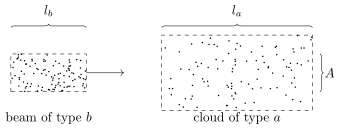
A cloud of length la comprised of particles a is at rest. A second cloud (a beam) of type b and length lb is moving in to collide with the first cloud. The beam's cross-sectional area is A
Figure 3: A beam of particles of type bb is shot at a cloud of particles of type aa. The beam has length lbl_{b} and the target lal_{a}. The cross sectional area of the target being hit by the beam is AA.

For a 2f2\to f process of momenta pa,pbp1,,pfp_{a},p_{b}\to p_{1},...,p_{f}, we have from (231)

dPa,bfV=1(2Ea)(2Eb)(2π)4δ(4)(PiPf)|f|𝒯|a,b|2(n=1fd3pn(2π)32En).\displaystyle\frac{{\rm d}P_{a,b\to f}}{V}=\frac{1}{(2E_{a})(2E_{b})}(2\pi)^{4% }\delta^{(4)}(P_{i}-P_{f})\ \big{|}\langle{f}|\mathcal{T}|{a,b}\rangle\big{|}^% {2}\Bigg{(}\prod_{n=1}^{f}\frac{{\rm d}^{3}p_{n}}{(2\pi)^{3}2E_{n}}\Bigg{)}\,. (233)

Keep in mind that the volume here is the spacetime volume of the scattering, i.e. V=tAlaV=t\cdot A\cdot l_{a}. For a single scattering, the probability PP is the number of scattered particles. Therefore the cross section

dσ=dPa,bflalbA=dPa,bfVtlb.\displaystyle{\rm d}\sigma=\frac{{\rm d}P_{a,b\to f}}{l_{a}\,l_{b}\,A}=\frac{{% \rm d}P_{a,b\to f}}{V}\frac{t}{l_{b}}\,. (234)

Identifying lb/tl_{b}/t as the velocity of the beam relative to our cloud of particles aa, we can now write

dσ=dPa,bfV|v|=1(2Ea)(2Eb)|v|(n=1fd3pn(2π)32En)(2π)4δ(4)(pa+pbn=1fpn)dΦ2f|f|𝒯|a,b|2|(a,bf)|2.\displaystyle{\rm d}\sigma=\frac{{\rm d}P_{a,b\to f}}{V|\vec{v}|}=\frac{1}{(2E% _{a})(2E_{b})|\vec{v}|}\underbrace{\Bigg{(}\prod_{n=1}^{f}\frac{{\rm d}^{3}p_{% n}}{(2\pi)^{3}2E_{n}}\Bigg{)}(2\pi)^{4}\delta^{(4)}\Bigg{(}p_{a}+p_{b}-\sum_{n% =1}^{f}p_{n}\Bigg{)}}_{{\rm d}\Phi_{2\to f}}\ \underbrace{\big{|}\langle{f}|% \mathcal{T}|{a,b}\rangle\big{|}^{2}}_{|\mathcal{M}(a,b\to f)|^{2}}\,. (235)

We now need to convince ourselves that dσ{\rm d}\sigma is Lorentz invariant since we could otherwise stop a process from happening simply by moving relative to it. We have already seen that the measure d3p/(2E){\rm d}^{3}p/(2E) is invariant, making the entire phase space dΦ{\rm d}\Phi Lorentz invariant. The matrix element (a,bf)\mathcal{M}(a,b\to f) is also fine so that the remaining part is the flux factor EaEb|v|E_{a}E_{b}|\vec{v}|. We an rewrite this in terms of invariants77 7 Note that technically this is only invariant for boosts along the beam axis. For boosts along any other axis, it is not invariant which fits well with our intuition of cross-sectional areas.

EaEb|v|=(papb)2ma2mb2\displaystyle E_{a}E_{b}|\vec{v}|=\sqrt{(p_{a}\cdot p_{b})^{2}-m_{a}^{2}m_{b}^% {2}} (236)
The image is a line graph titled ATLAS Online Luminosity, displaying data on delivered luminosity (measured in inverse femtobarns) across different years from 2011 to 2025. The horizontal axis represents the months of the year, spanning from January to October, while the vertical axis indicates the delivered luminosity, ranging from 0 to 140fb^-1.
2011: Shows lower luminosity values, starting from nearly 0 and reaching just over 20 fb^-1 by October.
2012: Displays increasing luminosity, peaking at about 40 fb^-1.
2013: Marks a steady rise, reaching around 50 fb^-1 by late October.
2014: Sees a gradual increase, finishing near 60 fb^-1.
2015: Has a sharp rise, culminating at about 80 fb^-1.
2016: Continues to grow, reaching approximately 90 fb^-1.
2017: Shows similar growth trends to the previous year, reaching nearly 100 fb^-1.
2018: Jumps to about 120 fb^-1 by October.
2019: Observes a steady increase, finishing at around 110 fb^-1.
2020: Decreases slightly, with values around 90 fb^-1.
2021: Displays rapid growth, reaching about 125 fb^-1.
2022: Nears 130 fb^-1 by October.
2023: Consistently climbs, finishing close to 135 fb^-1.
2024: Projections indicate a rise, reaching around 138 fb^-1.
2025: Displays an anticipated further increase, nearing 140 fb^-1.
The image is a line graph titled CMS Luminosity, displaying data on total integrated livered luminosity (measured in inverse femtobarns) across different years from 2010 to 2025. The horizontal axis represents the months of the year, spanning from April to December, while the vertical axis indicates the delivered luminosity, ranging from 0 to 150fb^-1.
2010: Shows the initial rise in integrated luminosity, starting from zero and peaking around May.
2011: Starts from a low value in April and shows a gradual increase through the summer months, with a sharper rise in October.
2012: Begins lower than the 2011 line but rises more steeply after July, indicating a successful run ramp-up.
2015: Starts at a low point in April and shows a gradual increase, with significant growth evident by July, indicating a successful operational period despite fewer data points than previous years.
2016: Begins at a similar point as 2015 but exhibits a much steeper upward trend, reaching a peak around the middle of the year and maintaining high luminosity through the fall.
2017: Shows a consistent increase throughout the year, with notable spikes in data collection, reflecting advancements in experimental techniques that boost luminosity.
2018: Starts similarly to 2017 but with a slightly lower peak, indicating a reduction in the total luminosity achieved that year.
2021: Demonstrates a significant increase in luminosity, with rapid growth throughout the summer months, clearly surpassing previous years' totals.
2022: Although starting strong, it shows fluctuations in the data collection progress but still maintains a higher overall luminosity than earlier years like 2011 and 2012.
2023: Exhibits a steep growth trend, indicating ongoing advancements and upgrades in the CMS, reaching considerable luminosity levels by September.
2025: The predicted output shows a steady increase that maintains a high trajectory, suggesting further enhancements in data collection and processing capabilities expected by the end of the year.
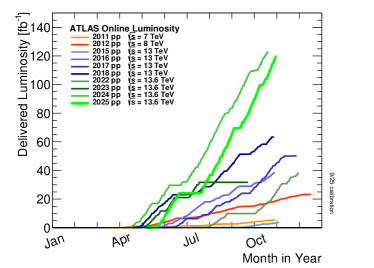
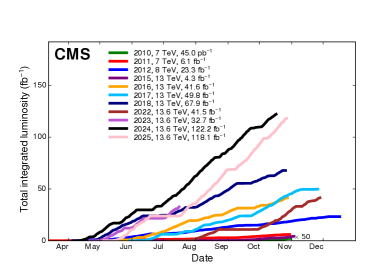
Figure 4: The integrated luminosity recorded by the ATLAS (left) and CMS (right) experiments since 2021. 2024 had a (at the time of writing) record-breaking 122.6fb1122.6\,{\rm fb}^{-1}.
A line graph showing cross section σin fb across varying center-of-mass energy levels (\sqrt{s} / TeV) and represents different particle interactions: Total, Z, ggH, ttH, and HH. The x-axis is labeled as the center-of-mass energy \sqrt{s} in TeV, ranging from approximately 5 to 14 TeV, while the y-axis is the cross section σin fb, with values ranging from 10−2 to 103 femtobarns. Each process is indicated by a uniquely colored line:
Total: Displays a steady increase as energy increases, indicating a broad range of events.
Z: Shows a relatively flat trend with slight increases, peaking around 91 GeV, suggesting a stable production rate.
ggH: Exhibits a more pronounced rise, indicating increasing production with energy, significant for analyzing Higgs boson interactions.
ttH: Demonstrates a gradual increase, reflecting the growing likelihood of producing top quark pairs in high-energy collisions.
HH: Displays considerable fluctuation but trends upward, suggesting complex interactions leading to double Higgs boson production.
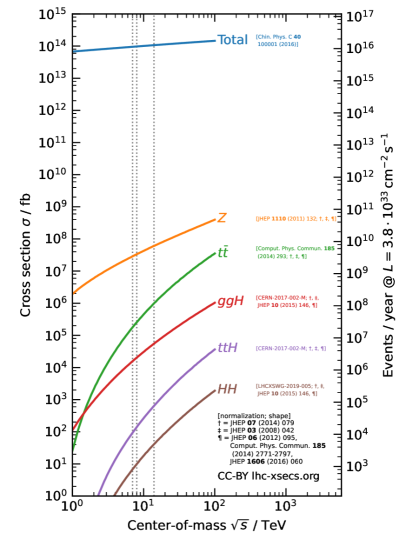
Figure 5: The cross sections of various LHC processes
Example numbers from the LHC

When talking about luminosity, we either refer to the instantaneous luminosity LL which is measured in cm2s1{\rm cm}^{-2}{\rm s}^{-1} or the integrated luminosity L\int L which is measured in fb1{\rm fb}^{-1}. An instantaneous luminosity of L=1032cm2s1L=10^{32}\,{\rm cm}^{-2}{\rm s}^{-1} for an entire year corresponds to L=3.15fb1\int L=3.15\,{\rm fb}^{-1}.

In 2024, the integrated luminosity of the LHC was around 2024L=122.6fb1\int_{2024}L=122.6\,{\rm fb}^{-1}. The LHC experiments regularly publish plots that show the luminosity recorded as a function of time over the year. The current version is reproduced in Figure 5. At the time of the Higgs discovery (summer 2012), we had only recorded about 12fb112\,{\rm fb}^{-1}, slightly more than recorded in any given month. You can use the numbers for various cross sections (e.g. σ(ppX)1014fb\sigma(pp\to X)\approx 10^{14}\,{\rm fb} or σ(ppH)5×10⁴fb\sigma(pp\to H)\approx 5\times 10^{4}\,{\rm fb}) to find the number of events expected per year. cf. Figure 5.

4.2 One initial state: decay rates

If we have only one particle in the initial state, the only interesting thing that can happen is that this particle decays. We may wonder what the lifetime τ\tau of this particle is or, if it has multiple possible decay channels, what the relative probabilities between the channels is. To do this, we define the decay rate Γ=1/τ\Gamma=1/\tau which will be larger for shorter-lived particles (i.e. those with a larger transition probability)

dΓ=dPafV=12M(n=1fd3pn(2π)32En)(2π)4δ(4)(pan=1fpn)dΦ1f|f|𝒯|a,b|2|(af)|2,\displaystyle{\rm d}\Gamma=\frac{{\rm d}P_{a\to f}}{V}=\frac{1}{2M}\underbrace% {\Bigg{(}\prod_{n=1}^{f}\frac{{\rm d}^{3}p_{n}}{(2\pi)^{3}2E_{n}}\Bigg{)}(2\pi% )^{4}\delta^{(4)}\Bigg{(}p_{a}-\sum_{n=1}^{f}p_{n}\Bigg{)}}_{{\rm d}\Phi_{1\to f% }}\ \underbrace{\big{|}\langle{f}|\mathcal{T}|{a,b}\rangle\big{|}^{2}}_{|% \mathcal{M}(a\to f)|^{2}}\,, (237)

where we have used that in the rest frame of aa the energy Ea=ME_{a}=M

4.3 Examples

Let us consider a few example of this. We will use a modified version of the ϕ3\phi^{3} theory we discussed in the previous section that contains two fields ϕ1\phi_{1} and ϕ2\phi_{2}

=12(μϕ1)(μϕ1)12M2ϕ12+12(μϕ2)(μϕ2)12m2ϕ2212!λϕ1ϕ22.\displaystyle\mathcal{L}=\frac{1}{2}(\partial_{\mu}\phi_{1})(\partial^{\mu}% \phi_{1})-\frac{1}{2}M^{2}\phi_{1}^{2}+\frac{1}{2}(\partial_{\mu}\phi_{2})(% \partial^{\mu}\phi_{2})-\frac{1}{2}m^{2}\phi_{2}^{2}-\frac{1}{2!}\lambda\phi_{% 1}\phi_{2}^{2}\,. (238)

The Feynman rules of this theory are

For each ϕ1\phi_{1}-ϕ2\phi_{2}-ϕ2\phi_{2} vertex
Vertex of one ϕ1 and two ϕ2 fields
=iλ,\displaystyle=-i\lambda\,, (239)
For each internal ϕ1\phi_{1} line
Propagator of the ϕ1 field with momentum p
=ip2M2+iϵ,\displaystyle=\frac{i}{p^{2}-M^{2}+i\epsilon}\,, (240)
For each internal ϕ2\phi_{2} line
Propagator of the ϕ2 field with momentum p
=ip2m2+iϵ.\displaystyle=\frac{i}{p^{2}-m^{2}+i\epsilon}\,. (241)

We could have derived the Feynman rules using the Wick theorem as we did above. Alternatively, we could follow the heuristic of taking a prefactor of i-i, multiplying the coefficient of the fields (λ/2!\lambda/2!) and multiply with the symmetry factor (1!1! for the ϕ11\phi_{1}^{1} factor and 2!2! for the ϕ22\phi_{2}^{2} factor).

4.3.1 Decay process ϕ1ϕ2ϕ2\phi_{1}\to\phi_{2}\phi_{2}

If we assume that M>2mM>2m, the ϕ1\phi_{1} particle can decay into two ϕ2\phi_{2} particles. To do this, let us begin by calculating the matrix element \mathcal{M} which is trivial in this case

(ϕ1(P)ϕ2(p1)ϕ2(p2))=
A ϕ1 particle decaying into two ϕ2 particles
=iλ.
\displaystyle\mathcal{M}\big{(}\phi_{1}(P)\to\phi_{2}(p_{1})\phi_{2}(p_{2})% \big{)}=\includegraphics{bmlimages/notes-133.svg}\bml@image@depth{133}% \bmlDescription{A \phi 1 particle decaying into two \phi 2 particles}\quad=-i% \lambda\,.
(242)

The decay rate therefore is

Γ(ϕ1ϕ2ϕ2)\displaystyle\Gamma(\phi_{1}\to\phi_{2}\phi_{2}) =12M(2π)4δ(4)(Pp1p2)d3p1(2π)32E1d3p2(2π)32E2||2\displaystyle=\frac{1}{2M}\int(2\pi)^{4}\delta^{(4)}\Big{(}P-p_{1}-p_{2}\Big{)% }\frac{{\rm d}^{3}p_{1}}{(2\pi)^{3}2E_{1}}\frac{{\rm d}^{3}p_{2}}{(2\pi)^{3}2E% _{2}}|\mathcal{M}|^{2} (243)
=12M(2π)δ(ME1E2)2E1d3p2(2π)32E2λ2.\displaystyle=\frac{1}{2M}\int\frac{(2\pi)\delta\Big{(}M-E_{1}-E_{2}\Big{)}}{2% E_{1}}\frac{{\rm d}^{3}p_{2}}{(2\pi)^{3}2E_{2}}\lambda^{2}\,. (244)

As always we have Ei=pi 2+m2E_{i}=\sqrt{\vec{p}_{i}^{\,2}+m^{2}} and since p1=p2\vec{p}_{1}=-\vec{p}_{2}, we have E1=E2E_{1}=E_{2}. We can now write the d3p2{\rm d}^{3}p_{2} integration in spherical coordinates, i.e. d3p2=|p2|2d|p2|dΩ{\rm d}^{3}p_{2}=|\vec{p}_{2}|^{2}{\rm d}|\vec{p}_{2}|{\rm d}\Omega

Γ(ϕ1ϕ2ϕ2)\displaystyle\Gamma(\phi_{1}\to\phi_{2}\phi_{2}) =12M(2π)δ(M2E2)4E22dΩ|p2|2d|p2|(2π)3λ2.\displaystyle=\frac{1}{2M}\int\frac{(2\pi)\delta\big{(}M-2E_{2}\big{)}}{4E_{2}% ^{2}}\frac{{\rm d}\Omega|\vec{p}_{2}|^{2}{\rm d}|\vec{p}_{2}|}{(2\pi)^{3}}% \lambda^{2}\,. (245)

Since there is no angular dependence, we can solve the dΩ{\rm d}\Omega integral and obtain 4π4\pi. To solve the d|p2|{\rm d}|\vec{p}_{2}| integration, we can perform a substitution d|p2|=dE2×E2/E22m2{\rm d}|\vec{p}_{2}|={\rm d}E_{2}\times E_{2}/\sqrt{E_{2}^{2}-m^{2}}

Γ(ϕ1ϕ2ϕ2)\displaystyle\Gamma(\phi_{1}\to\phi_{2}\phi_{2}) =λ28πdE2E2E22m2Mδ(M2E2)=λ216πM14m2/M2.\displaystyle=\frac{\lambda^{2}}{8\pi}\int\frac{{\rm d}E_{2}}{E_{2}}\frac{% \sqrt{E_{2}^{2}-m^{2}}}{M}\delta(M-2E_{2})=\frac{\lambda^{2}}{16\pi M}\sqrt{1-% 4m^{2}/M^{2}}\,. (246)

We can identify 14m2/M2\sqrt{1-4m^{2}/M^{2}} as the velocity of one of the ϕ2\phi_{2} particles since it is defined as

β=|p1|E1=1m2E12=14m2M2,\displaystyle\beta=\frac{|\vec{p}_{1}|}{E_{1}}=\sqrt{1-\frac{m^{2}}{E_{1}^{2}}% }=\sqrt{1-\frac{4m^{2}}{M^{2}}}\,, (247)

with E1=M/2E_{1}=M/2.

Suggested Exercise

Can you explain why we required M>2mM>2m based on this answer? What happens to β\beta for M<2mM<2m, for M=2mM=2m or for M2mM\gg 2m?

The region M=2mM=2m is referred to as the threshold where the decay is just about possible and the two final-state particles are produced at rest.

Suggested Exercise

The decay ϕ1ϕ2ϕ2ϕ2ϕ2\phi_{1}\to\phi_{2}\phi_{2}\phi_{2}\phi_{2} is also possible. How would you go about calculating this? The first Feynman diagram would be

A ϕ1 particle decaying into two ϕ2 particles. One of the ϕ2 emits another ϕ1 which again decays into another pair of ϕ2
=(iλ)i(Pp4)2m2+iϵ(iλ)i(p2+p3)2M2+iϵ.
\displaystyle\includegraphics{bmlimages/notes-134.svg}\bml@image@depth{134}% \bmlDescription{A \phi 1 particle decaying into two \phi 2 particles. One of % the \phi 2 emits another \phi 1 which again decays into another pair of \phi 2% }\quad=(-i\lambda)\frac{i}{(P-p_{4})^{2}-m^{2}+i\epsilon}(-i\lambda)\frac{i}{(% p_{2}+p_{3})^{2}-M^{2}+i\epsilon}\,.
(248)

There are more diagrams due to the permutations of the outgoing particles. Convince yourself of the above and calculate the full amplitude.

More generally, it is useful to keep

dΦ2=dΩ116π2|p1|Ecm\displaystyle\int{\rm d}\Phi_{2}=\int{\rm d}\Omega\frac{1}{16\pi^{2}}\frac{|% \vec{p}_{1}|}{E_{\rm cm}} (249)

in mind. Here Ecm=ME_{\rm cm}=M and the dΩ{\rm d}\Omega integral was trivial.

4.3.2 Scattering of ϕ2ϕ2ϕ2ϕ2\phi_{2}\phi_{2}\to\phi_{2}\phi_{2}

Let us now calculate the scattering of two ϕ2\phi_{2} particles. The amplitude \mathcal{M} contains three diagrams

(ϕ2(p1)\displaystyle\mathcal{M}\big{(}\phi_{2}(p_{1}) ϕ2(p2)ϕ2(p3)ϕ2(p4))=
Two ϕ2 particles (p1 and p2) annihilating into a ϕ1 particle which then decays into two ϕ2 (p3 and p4)
+
Two ϕ2 particles (p1 and p2) scattering through a ϕ1 particle. This is the rotated version of the previous diagram
+
Same as previous but p3 and p4 are flipped
\displaystyle\phi_{2}(p_{2})\to\phi_{2}(p_{3})\phi_{2}(p_{4})\big{)}=% \includegraphics{bmlimages/notes-135.svg}\bml@image@depth{135}\bmlDescription{% Two \phi 2 particles (p1 and p2) annihilating into a \phi 1 particle which % then decays into two \phi 2 (p3 and p4)}+\includegraphics{bmlimages/notes-136.% svg}\bml@image@depth{136}\bmlDescription{Two \phi 2 particles (p1 and p2) % scattering through a \phi 1 particle. This is the rotated version of the % previous diagram}+\includegraphics{bmlimages/notes-137.svg}\bml@image@depth{13% 7}\bmlDescription{Same as previous but p3 and p4 are flipped}
(250)
=(iλ)i(p1+p2)2M2(iλ)+(iλ)i(p1p3)2M2(iλ)+(iλ)i(p1p4)2M2(iλ)\displaystyle=(-i\lambda)\frac{i}{(p_{1}+p_{2})^{2}-M^{2}}(-i\lambda)+(-i% \lambda)\frac{i}{(p_{1}-p_{3})^{2}-M^{2}}(-i\lambda)+(-i\lambda)\frac{i}{(p_{1% }-p_{4})^{2}-M^{2}}(-i\lambda)
=iλ2(1sM2+1tM2+1uM2).\displaystyle=-i\lambda^{2}\bigg{(}\frac{1}{s-M^{2}}+\frac{1}{t-M^{2}}+\frac{1% }{u-M^{2}}\bigg{)}\,. (251)

Here we have defined the Mandelstam variables

s=(p1+p2)2=(p3+p4)2,t=(p1p3)2=(p2p4)2,u=(p1p4)2=(p2p3)2.\displaystyle s=(p_{1}+p_{2})^{2}=(p_{3}+p_{4})^{2}\,,\quad t=(p_{1}-p_{3})^{2% }=(p_{2}-p_{4})^{2}\,,\quad u=(p_{1}-p_{4})^{2}=(p_{2}-p_{3})^{2}\,. (252)
Suggested Exercise

Use momentum conservation to show that s+t+u=4m2s+t+u=4m^{2}.

The Lorentz-invariant phase space is calculated the same way as before

dΦ22=d3p3(2π)32E3d3p4(2π)32E4(2π)4δ(4)(p1+p2p3p4)=dΩ116π2|p3|Ecm,\displaystyle\int{\rm d}\Phi_{2\to 2}=\int\frac{{\rm d}^{3}p_{3}}{(2\pi)^{3}2E% _{3}}\frac{{\rm d}^{3}p_{4}}{(2\pi)^{3}2E_{4}}(2\pi)^{4}\delta^{(4)}\Big{(}p_{% 1}+p_{2}-p_{3}-p_{4}\Big{)}=\int{\rm d}\Omega\frac{1}{16\pi^{2}}\frac{|\vec{p}% _{3}|}{E_{\rm cm}}\,, (253)

with Ecm=E1+E2E_{\rm cm}=E_{1}+E_{2}. Unfortunately we now cannot replace dΩ=4π{\rm d}\Omega=4\pi because we still have an angular dependency. To see why, let us write down explicit four vectors in the centre-of-mass frame where p1+p2=0\vec{p}_{1}+\vec{p}_{2}=0. For simplicity, we align our coordinate system such that the beam axis is the zz direction and that the scattering takes place in the yy-zz plane

p1\displaystyle p_{1} =\displaystyle= (E,0,0,+|p1|)\displaystyle\big{(}E,0,0,+|\vec{p}_{1}|\big{)} =\displaystyle= (E,0,0,+E2m2),\displaystyle\big{(}E,0,0,+\sqrt{E^{2}-m^{2}}\big{)}\,, (254)
p2\displaystyle p_{2} =\displaystyle= (E,0,0,|p2|)\displaystyle\big{(}E,0,0,-|\vec{p}_{2}|\big{)} =\displaystyle= (E,0,0,E2m2),\displaystyle\big{(}E,0,0,-\sqrt{E^{2}-m^{2}}\big{)}\,, (255)
p3\displaystyle p_{3} =\displaystyle= (E,0,+sinθ|p3|,+cosθ|p3|)\displaystyle\big{(}E,0,+\sin\theta|\vec{p}_{3}|,+\cos\theta|\vec{p}_{3}|\big{)} =\displaystyle= (E,0,+sinθE2m2,+cosθE2m2),\displaystyle\big{(}E,0,+\sin\theta\sqrt{E^{2}-m^{2}},+\cos\theta\sqrt{E^{2}-m% ^{2}}\big{)}\,, (256)
p4\displaystyle p_{4} =\displaystyle= (E,0,sinθ|p4|,cosθ|p4|)\displaystyle\big{(}E,0,-\sin\theta|\vec{p}_{4}|,-\cos\theta|\vec{p}_{4}|\big{)} =\displaystyle= (E,0,sinθE2m2,cosθE2m2).\displaystyle\big{(}E,0,-\sin\theta\sqrt{E^{2}-m^{2}},-\cos\theta\sqrt{E^{2}-m% ^{2}}\big{)}\,. (257)

Since EE1=|p1|2m2=E2E\equiv E_{1}=\sqrt{|\vec{p}_{1}|^{2}-m^{2}}=E_{2}. For the same reason, p3+p4=0\vec{p}_{3}+\vec{p}_{4}=0 and E3=E4E_{3}=E_{4}. The Mandelstam variables are

s\displaystyle s =(2E,0,0,0)2=4E2=Ecm2,\displaystyle=\big{(}2E,0,0,0\big{)}^{2}=4E^{2}=E_{\rm cm}^{2}\,, (258a)
t\displaystyle t =(0,0,sinθ,(+1cosθ))2(E2m2)=2(E2m2)(1cosθ),\displaystyle=\big{(}0,0,-\sin\theta,(+1-\cos\theta)\big{)}^{2}(E^{2}-m^{2})=-% 2(E^{2}-m^{2})(1-\cos\theta)\,, (258b)
u\displaystyle u =(0,0,+sinθ,(1cosθ))2(E2m2)=2(E2m2)(1+cosθ).\displaystyle=\big{(}0,0,+\sin\theta,(-1-\cos\theta)\big{)}^{2}(E^{2}-m^{2})=-% 2(E^{2}-m^{2})(1+\cos\theta)\,. (258c)

We can now write the differential cross section as

dσ\displaystyle{\rm d}\sigma =1(2E)2|v|dΩ16π2E2m22Eλ4(1sM2+1tM2+1uM2)2\displaystyle=\frac{1}{(2E)^{2}|\vec{v}|}\frac{{\rm d}\Omega}{16\pi^{2}}\frac{% \sqrt{E^{2}-m^{2}}}{2E}\lambda^{4}\bigg{(}\frac{1}{s-M^{2}}+\frac{1}{t-M^{2}}+% \frac{1}{u-M^{2}}\bigg{)}^{2} (259)
=dΩ64π2λ4E2(M24E2)2(14E42m4+4m2(2M23E2)3M4+2(m2E2)2cos(2θ)(2E22m2+M2)24(m2E2)2cos2θ)2.\displaystyle=\frac{{\rm d}\Omega}{64\pi^{2}}\frac{\lambda^{4}}{E^{2}(M^{2}-4E% ^{2})^{2}}\Bigg{(}\frac{14E^{4}-2m^{4}+4m^{2}(2M^{2}-3E^{2})-3M^{4}+2(m^{2}-E^% {2})^{2}\cos(2\theta)}{(2E^{2}-2m^{2}+M^{2})^{2}-4(m^{2}-E^{2})^{2}\cos^{2}% \theta}\Bigg{)}^{2}\,. (260)

If we set M=m=0M=m=0, we find a very short expression

dσ=dΩ1024π2λ4E6(3+cos2θ)2(1cos2θ)2.\displaystyle{\rm d}\sigma=\frac{{\rm d}\Omega}{1024\pi^{2}}\frac{\lambda^{4}}% {E^{6}}\frac{(3+\cos^{2}\theta)^{2}}{(1-\cos^{2}\theta)^{2}}\,. (261)

What do we now do with this object? We can either visualise the differential distribution dσ/dΩ{\rm d}\sigma/{\rm d}\Omega, normally written as dσ/d(cosθ){\rm d}\sigma/{\rm d}(\cos\theta) or dσ/dθ{\rm d}\sigma/{\rm d}\theta. Alternatively, we could integrate over dΩ{\rm d}\Omega and obtain the full cross section of this process occurring.

A few comments are in-order. From (258) it is clear that s=4E24m2>0s=4E^{2}\geq 4m^{2}>0 and t,u0t,u\leq 0. This means the second and third term in (259) will not be a problem as long M0M\neq 0. However, s=M2s=M^{2} is allowed and the cross section would explode if we picked this value of ss. This is fixed by adding higher-order corrections to the ϕ1\phi_{1} propagator, i.e.

+
+
+
.
\displaystyle\includegraphics{bmlimages/notes-138.svg}\bml@image@depth{138}+% \includegraphics{bmlimages/notes-139.svg}\bml@image@depth{139}+% \includegraphics{bmlimages/notes-140.svg}\bml@image@depth{140}+\cdots\,.
(262)

Even though each term is progressively more suppressed by λ\lambda, the addition of more propagators 1/(sM2)1/(s-M^{2}) makes up for this and we need to calculate infinitely many such insertions. We will come back to this in Section 7 and Appendix A.

We should also note the behaviour of (261) for cosθ±1\cos\theta\to\pm 1. This corresponds to a scattering angle of θ=0\theta=0 or θ=π\theta=\pi, i.e. when the outgoing particles follow the beam axis. Since the two ϕ2\phi_{2} particles are indistinguishable, this just means that the particles pass each other without interacting. The divergence we see here is to the fact that we have split the 𝒮\mathcal{S} matrix as 𝒮=1+𝒯\mathcal{S}=1+\mathcal{T} in (227). When we constructed 𝒯\mathcal{T} we assumed that the initial and final state were different which is not the case for cosθ=±1\cos\theta=\pm 1.