2 Free quantised scalar field

We are now almost ready to quantise the scalar field ϕ\phi, that is, find a QFT that follows the KG field as specified by the Lagrangian (51). In this section we will consider this field to be a free field, i.e. one that has no interactions, not even with itself. This is not a very realistic description of nature but it is a very important first step. Our description of realistic interacting fields will largely be based on free fields and we will consider the interaction as a small perturbation.

Our discussion is analogous to going from a finite-dimensional Lagrangian problem, where we had nn degrees of freedom that each took a numeric value, to a classical field theory, where we assigned each point in spacetime a value ϕ(x)\phi(x). When describing such a system using QM, we defined operators for the position and momentum of each of these particles. Similarly, a quantum field is assigns an operator to every point in spacetime. Before we can actually write down these fields we need to do a bit more revising.

2.1 Heisenberg and Schrödinger pictures

Most discussions of QM describe the wavefunction as dynamic and time dependent and the operators acting on them as static. This is called the Schrödinger picture which describes wavefunctions as manifestly time dependent through the Schrödinger equation (2)

itΨS(x,t)\displaystyle i\frac{\partial}{\partial t}\Psi_{S}(x,t) =[12m2x2+V]H^SΨS(x,t).\displaystyle=\underbrace{\Big{[}-\frac{1}{2m}\frac{\partial^{2}}{\partial x^{% 2}}+V\Big{]}}_{\hat{H}_{S}}\Psi_{S}(x,t)\,. (2)

The Hamiton operator H^S\hat{H}_{S} itself does not depend on time.33 3 Note that for a brief period we will use a hat to indicate that an object is an operator Starting from some initial state |ΨS(0)|{\Psi_{S}(0)}\rangle, the time evolution of the state is described by

|ΨS(t)=U^(t)|ΨS(0).\displaystyle|{\Psi_{S}(t)}\rangle=\hat{U}(t)|{\Psi_{S}(0)}\rangle\,. (65)

The operator U^(t)\hat{U}(t) fulfils the differential equation

iU^t=H^SU^.\displaystyle i\frac{\partial\hat{U}}{\partial t}=\hat{H}_{S}\hat{U}\,. (66)

Please keep in mind that this is a differential equation for an operator rather than a function. To ensure that Ψ|Ψ\langle{\Psi}|{\Psi}\rangle remains unchanged, we need the operator U^\hat{U} to be unitary, i.e. U^1=U^\hat{U}^{-1}=\hat{U}^{\dagger}.

This picture is not ideal to derive a QFT in because the language we have developed for field theories explicitly talks about time dependence. Instead, we will use the Heisenberg picture where operators depend on time while states do not. To transform between the two pictures, we will use a unitary operator. The state of our system as it was at t=0t=0 obviously does not depend on time which makes it our new state vector

|ΨH=U^1(t)|ΨS(t)=U^(t)|ΨS(t)=|ΨS(0).\displaystyle|{\Psi_{H}}\rangle=\hat{U}^{-1}(t)|{\Psi_{S}(t)}\rangle=\hat{U}^{% \dagger}(t)|{\Psi_{S}(t)}\rangle=|{\Psi_{S}(0)}\rangle\,. (67)

To make use of this new picture, we also need to consider how an arbitrary operator O^S\hat{O}_{S} transforms. It is not difficult to see that

O^H(t)=U^(t)O^SU^(t)\displaystyle\hat{O}_{H}(t)=\hat{U}^{\dagger}(t)\hat{O}_{S}\hat{U}(t) (68)

leaves observables invariant. Crucially for what we are about to attempt, this transformation also leaves the commutation relation between q^\hat{q} and p^\hat{p} invariant

[q^H(t),p^H(t)]=U(t)[q^S,p^S]U(t)=iU(t)U(t)=i.\displaystyle[\hat{q}_{H}(t),\hat{p}_{H}(t)]=U^{\dagger}(t)[\hat{q}_{S},\hat{p% }_{S}]U(t)=iU^{\dagger}(t)U(t)=i\,. (69)

This new operator fulfils the EoM if O^\hat{O} has explicit time dependence through the Heisenberg equation assuming O^H\hat{O}_{H} has no explicit time dependence

idO^Hdt=[O^H,H^H]O^HH^HH^HO^H.\displaystyle i\frac{{\rm d}\hat{O}_{H}}{{\rm d}t}=[\hat{O}_{H},\hat{H}_{H}]% \equiv\hat{O}_{H}\hat{H}_{H}-\hat{H}_{H}\hat{O}_{H}\,. (70)

This is very similar to the classical equivalent Poisson bracket

dOdt={O,H}.\displaystyle\frac{{\rm d}O}{{\rm d}t}=\{O,H\}\,. (71)
Suggested Exercise

Show that (68) indeed leaves expectation values invariant and that the EoM is follows from the Schrödinger equation.

From now on we will always assume the Heisenberg picture and drop in the subscript HH.

2.2 Equal-time canonical commutation relations

One of the first things we have learned about QM was that the position and momentum operators do not commute, i.e. [q^,p^]=i[\hat{q},\hat{p}]=i. Extending this for multiple particles, we can define the operator for the position (or momentum) of the ii-th particle as q^i\hat{q}_{i} (p^i\hat{p}_{i}). In position space, these just take the form

q^k|Ψ(q1,,qn)=qk|Ψ(q1,,qn)andp^k|Ψ(q1,,qn)=iqk|Ψ(q1,,qn)\displaystyle\hat{q}_{k}|{\Psi(q_{1},\cdots,q_{n})}\rangle=q_{k}|{\Psi(q_{1},% \cdots,q_{n})}\rangle\quad\text{and}\quad\hat{p}_{k}|{\Psi(q_{1},\cdots,q_{n})% }\rangle=-i\frac{\partial}{\partial q_{k}}|{\Psi(q_{1},\cdots,q_{n})}\rangle (72)

The commutation relation is now extended to

[q^j,p^k]\displaystyle[\hat{q}_{j},\hat{p}_{k}] =iδjk,\displaystyle=i\delta_{jk}\,, (73a)
[q^j,q^k]\displaystyle[\hat{q}_{j},\hat{q}_{k}] =[p^j,p^k]=0,\displaystyle=[\hat{p}_{j},\hat{p}_{k}]=0\,, (73b)

since operators acting on different degrees of freedom will always commute. These are referred to as canonical commutation relations.

In the continuum limit, we have locations in space x\vec{x} instead indices jj, field operators ϕ^(x,t)\hat{\phi}(\vec{x},t) instead of coordinate operators q^i\hat{q}_{i}, and conjugate momenta operator π^(x,t)\hat{\pi}(\vec{x},t) instead of momentum operators p^i\hat{p}_{i}. We can now write the CCRs at equal time tt

[ϕ^(x,t),π^(x,t)]\displaystyle[\hat{\phi}(\vec{x},t),\hat{\pi}(\vec{x}^{\,\prime},t)] =iδ(3)(xx),\displaystyle=i\delta^{(3)}(\vec{x}-\vec{x}^{\,\prime})\,, (74)
[ϕ^(x,t),ϕ^(x,t)]\displaystyle[\hat{\phi}(\vec{x},t),\hat{\phi}(\vec{x}^{\,\prime},t)] =[π^(x,t),π^(x,t)]=0.\displaystyle=[\hat{\pi}(\vec{x},t),\hat{\pi}(\vec{x}^{\,\prime},t)]=0\,. (75)

Note that these are in the Heisenberg picture as they depend on time! While this looks like it might not be Lorentz invariant (after all, we are treating time and space very different here), the formalism we are developing is invariant which will become clearer later.

We will get a better idea of what the operator ϕ^\hat{\phi} actually does once we write down a solution that satisfies both \mathcal{L} and the CCRs. However, it is helpful to get an idea early on so it is a bit less abstract. Consider the vacuum state |0|{0}\rangle, i.e. a completely empty universe devoid of any particles (we will formalise this later as well but this suffices for now), as our initial state. We will see shortly that applying ϕ^(x,t)\hat{\phi}(\vec{x},t) on the vacuum will create a new particle at position x\vec{x}.

We can verify the EoM itϕ^=[ϕ^,H^]i\partial_{t}\hat{\phi}=[\hat{\phi},\hat{H}] and itπ^=[π^,H^]i\partial_{t}\hat{\pi}=[\hat{\pi},\hat{H}] follow from the CCRs. For this, we use that the Hamiltonian is (55)

H^=d3y^=d3y[12π^(y,t)2+12(yϕ^(y,t))2+12m2ϕ^(y,t)2]\displaystyle\hat{H}=\int{\rm d}^{3}y\ \hat{\mathcal{H}}=\int{\rm d}^{3}y\Big{% [}\frac{1}{2}\hat{\pi}(\vec{y},t)^{2}+\frac{1}{2}(\vec{\nabla}_{y}\hat{\phi}(% \vec{y},t))^{2}+\frac{1}{2}m^{2}\hat{\phi}(\vec{y},t)^{2}\Big{]} (76)

where we have used that for the KG field π=ϕ˙\pi=\dot{\phi} which translates to operators π^=ϕ^˙\hat{\pi}=\dot{\hat{\phi}}. We now calculate commutators

[ϕ^(x,t),^]=12[ϕ^(x,t),π^(y,t)2]+12[ϕ^(x,t),(yϕ^(y,t))2]+12m2[ϕ^(x,t),ϕ^(y,t)2].\displaystyle[\hat{\phi}(\vec{x},t),\hat{\mathcal{H}}]=\frac{1}{2}\big{[}\hat{% \phi}(\vec{x},t),\hat{\pi}(\vec{y},t)^{2}\big{]}+\frac{1}{2}\big{[}\hat{\phi}(% \vec{x},t),(\vec{\nabla}_{y}\hat{\phi}(\vec{y},t))^{2}\big{]}+\frac{1}{2}m^{2}% \big{[}\hat{\phi}(\vec{x},t),\hat{\phi}(\vec{y},t)^{2}\big{]}\,. (77)

Here the derivative in the y\vec{\nabla}_{y} operator is w.r.t. y\vec{y} and therefore it commutes with ϕ^(x,t)\hat{\phi}(\vec{x},t). Therefore,

[ϕ^(x,t),H^]=dyiπ^(y)δ(xy)=iπ^(x,t),\displaystyle[\hat{\phi}(\vec{x},t),\hat{H}]=\int{\rm d}y\ i\hat{\pi}(\vec{y})% \delta(\vec{x}-\vec{y})=i\hat{\pi}(\vec{x},t)\,, (78)

which is fulfilling the EoM as π^=ϕ^˙\hat{\pi}=\dot{\hat{\phi}}.

Suggested Exercise

Show that

[π^(x,t),H^]=i(2ϕ^(x,t)m2ϕ^(x,t)).\displaystyle[\hat{\pi}(\vec{x},t),\hat{H}]=i\Big{(}\nabla^{2}\hat{\phi}(\vec{% x},t)-m^{2}\hat{\phi}(\vec{x},t)\Big{)}\,. (79)

Together, we can deduce the KG equation as

[[ϕ^,H^],H^]=i[π^,H]=(2ϕ^(x,t)m2ϕ^(x,t))=i2π^˙=ϕ^¨.\displaystyle[[\hat{\phi},\hat{H}],\hat{H}]=i[\hat{\pi},H]=-\Big{(}\nabla^{2}% \hat{\phi}(\vec{x},t)-m^{2}\hat{\phi}(\vec{x},t)\Big{)}=i^{2}\dot{\hat{\pi}}=-% \ddot{\hat{\phi}}\,. (80)

2.3 Solution for the field operators

In (63) we have seen a solution ϕ(x,t)\phi(\vec{x},t) to the KG wave equation. To turn this into a solution for the field operator ϕ^\hat{\phi}, we promote the coefficients aa and aa^{*} to operators, i.e. aka^(k)a_{\vec{k}}\to\hat{a}(\vec{k}) and aka^(k)a_{\vec{k}}^{*}\to\hat{a}^{\dagger}(\vec{k}). Explicitly, we have for ϕ^\hat{\phi} and π^\hat{\pi} (now written in terms of the four-vector xx rather than x\vec{x} and tt)

ϕ^(x)=d3k(2π)312Ek[a^(k)eikx+a^(k)eikx],\displaystyle\hat{\phi}(x)=\int\frac{{\rm d}^{3}k}{(2\pi)^{3}}\sqrt{\frac{1}{2% E_{\vec{k}}}}\Big{[}\hat{a}(\vec{k}){\rm e}^{-ik\cdot x}+\hat{a}^{\dagger}(% \vec{k}){\rm e}^{ik\cdot x}\Big{]}\,, (81a)
π^(x)=d3k(2π)3(i)Ek2[a^(k)eikxa^(k)eikx],\displaystyle\hat{\pi}(x)=\int\frac{{\rm d}^{3}k}{(2\pi)^{3}}(-i)\sqrt{\frac{E% _{\vec{k}}}{2}}\Big{[}\hat{a}(\vec{k}){\rm e}^{-ik\cdot x}-\hat{a}^{\dagger}(% \vec{k}){\rm e}^{ik\cdot x}\Big{]}\,, (81b)

where we still have k0=Ekk^{0}=E_{\vec{k}}.

It is easy to be overwhelmed by the number of symbols in the equation above so let us focus on the relevant terms to schematically write

ϕ^(x)12Ek[a^(k)+a^(k)],\displaystyle\hat{\phi}(x)\sim\sqrt{\frac{1}{2E_{\vec{k}}}}\Big{[}\hat{a}(\vec% {k})+\hat{a}^{\dagger}(\vec{k})\Big{]}\,, (82a)
π^(x)(i)Ek2[a^(k)a^(k)].\displaystyle\hat{\pi}(x)\sim(-i)\sqrt{\frac{E_{\vec{k}}}{2}}\Big{[}\hat{a}(% \vec{k})-\hat{a}^{\dagger}(\vec{k})\Big{]}\,. (82b)

These equations should look very familiar as they are (up to the k\vec{k} dependence), the decomposition of x^\hat{x} and p^\hat{p} in terms of ladder operators a^\hat{a} and a^\hat{a}^{\dagger} of the quantum harmonic oscillator. We can find the CCRs for the a^\hat{a} and a^\hat{a}^{\dagger} operators as

[a^(p),a^(q)]\displaystyle[\hat{a}(\vec{p}),\hat{a}^{\dagger}(\vec{q})] =(2π)3δ(3)(pq),\displaystyle=(2\pi)^{3}\delta^{(3)}(\vec{p}-\vec{q})\,, (83a)
[a^(p),a^(q)]\displaystyle[\hat{a}(\vec{p}),\hat{a}(\vec{q})] =[a^(p),a^(q)]=0.\displaystyle=[\hat{a}^{\dagger}(\vec{p}),\hat{a}^{\dagger}(\vec{q})]=0\,. (83b)
Suggested Exercise

Show that these follow from the CCRs of ϕ^\hat{\phi} and π^\hat{\pi}. To do this, inverse-Fourier transform (81) to show that

a^(p)=12Epd3x[Epϕ^(x)+iπ^(x)]eipx,a^(p)=12Epd3x[Epϕ^(x)iπ^(x)]eipx.\displaystyle\begin{split}\hat{a}(\vec{p})&=\frac{1}{\sqrt{2E_{\vec{p}}}}\int{% \rm d}^{3}x\Big{[}E_{\vec{p}}\hat{\phi}(x)+i\hat{\pi}(x)\Big{]}{\rm e}^{ip% \cdot x}\,,\\ \hat{a}^{\dagger}(\vec{p})&=\frac{1}{\sqrt{2E_{\vec{p}}}}\int{\rm d}^{3}x\Big{% [}E_{\vec{p}}\hat{\phi}(x)-i\hat{\pi}(x)\Big{]}{\rm e}^{-ip\cdot x}\,.\end{split} (84)

Now you can calculate the commutators and reduce them to the CCRs.

The harmonic oscillator became a lot simpler once we wrote the Hamiltonian H^\hat{H} in terms of the ladder operators. We can do something similar here with one exception

H^\displaystyle\hat{H} =d3x[12π^(x,t)2+12(ϕ^(x,t))2+12m2ϕ^(x,t)2]\displaystyle=\int{\rm d}^{3}x\Big{[}\frac{1}{2}\hat{\pi}(\vec{x},t)^{2}+\frac% {1}{2}(\vec{\nabla}\hat{\phi}(\vec{x},t))^{2}+\frac{1}{2}m^{2}\hat{\phi}(\vec{% x},t)^{2}\Big{]} (85)
=d3xd3p(2π)3d3q(2π)3(EpEq4[a^(p)eipxa^(p)eipx][a^(q)eiqxa^(q)eiqx]pq4EpEq[a^(p)eipxa^(p)eipx][a^(q)eiqxa^(q)eiqx]+m24EpEq[a^(p)eipx+a^(p)eipx][a^(q)eiqx+a^(q)eiqx]).\displaystyle\begin{split}&=\int{\rm d}^{3}x\frac{{\rm d}^{3}p}{(2\pi)^{3}}% \frac{{\rm d}^{3}q}{(2\pi)^{3}}\Bigg{(}\frac{-\sqrt{E_{\vec{p}}E_{\vec{q}}}}{4% }\Big{[}\hat{a}(\vec{p}){\rm e}^{-ip\cdot x}-\hat{a}^{\dagger}(\vec{p}){\rm e}% ^{ip\cdot x}\Big{]}\Big{[}\hat{a}(\vec{q}){\rm e}^{-iq\cdot x}-\hat{a}^{% \dagger}(\vec{q}){\rm e}^{iq\cdot x}\Big{]}\\ &\qquad-\frac{\vec{p}\cdot\vec{q}}{4\sqrt{E_{\vec{p}}E_{\vec{q}}}}\Big{[}\hat{% a}(\vec{p}){\rm e}^{-ip\cdot x}-\hat{a}^{\dagger}(\vec{p}){\rm e}^{ip\cdot x}% \Big{]}\Big{[}\hat{a}(\vec{q}){\rm e}^{-iq\cdot x}-\hat{a}^{\dagger}(\vec{q}){% \rm e}^{iq\cdot x}\Big{]}\\ &\qquad+\frac{m^{2}}{4\sqrt{E_{\vec{p}}E_{\vec{q}}}}\Big{[}\hat{a}(\vec{p}){% \rm e}^{-ip\cdot x}+\hat{a}^{\dagger}(\vec{p}){\rm e}^{ip\cdot x}\Big{]}\Big{[% }\hat{a}(\vec{q}){\rm e}^{-iq\cdot x}+\hat{a}^{\dagger}(\vec{q}){\rm e}^{iq% \cdot x}\Big{]}\Bigg{)}\,.\end{split} (86)

Let us swap pp\vec{p}\to-\vec{p} and qq\vec{q}\to-\vec{q} in the terms that have a positive exponential. Note that this only changes the spatial components, i.e. px=EptpxEpt+px=2Eptpxp\cdot x=E_{\vec{p}}\cdot t-\vec{p}\cdot\vec{x}\to E_{\vec{p}}\cdot t+\vec{p}% \cdot x=2E_{\vec{p}}t-p\cdot x.

H^=d3xd3p(2π)3d3q(2π)3ei(p+q)x(EpEq4[a^(p)a^(p)e2iEpt][a^(q)a^(q)e2iEqt]pq4EpEq[a^(p)+a^(p)e2iEpt][a^(q)+a^(q)e2iEqt]+m24EpEq[a^(p)+a^(p)e2iEpt][a^(q)+a^(q)e2iEqt]).\displaystyle\begin{split}\hat{H}&=\int{\rm d}^{3}x\frac{{\rm d}^{3}p}{(2\pi)^% {3}}\frac{{\rm d}^{3}q}{(2\pi)^{3}}{\rm e}^{-i(p+q)\cdot x}\Bigg{(}\frac{-% \sqrt{E_{\vec{p}}E_{\vec{q}}}}{4}\Big{[}\hat{a}(\vec{p})-\hat{a}^{\dagger}(-% \vec{p}){\rm e}^{2iE_{\vec{p}}t}\Big{]}\Big{[}\hat{a}(\vec{q})-\hat{a}^{% \dagger}(-\vec{q}){\rm e}^{2iE_{\vec{q}}t}\Big{]}\\ &\qquad-\frac{\vec{p}\cdot\vec{q}}{4\sqrt{E_{\vec{p}}E_{\vec{q}}}}\Big{[}\hat{% a}(\vec{p})+\hat{a}^{\dagger}(-\vec{p}){\rm e}^{2iE_{\vec{p}}t}\Big{]}\Big{[}% \hat{a}(\vec{q})+\hat{a}^{\dagger}(-\vec{q}){\rm e}^{2iE_{\vec{q}}t}\Big{]}\\ &\qquad+\frac{m^{2}}{4\sqrt{E_{\vec{p}}E_{\vec{q}}}}\Big{[}\hat{a}(\vec{p})+% \hat{a}^{\dagger}(-\vec{p}){\rm e}^{2iE_{\vec{p}}t}\Big{]}\Big{[}\hat{a}(\vec{% q})+\hat{a}^{\dagger}(-\vec{q}){\rm e}^{2iE_{\vec{q}}t}\Big{]}\Bigg{)}\,.\end{split} (87)

We can use that

d3xei(p+q)x=(2π)3ei(Ep+Eq)tδ(3)(p+q)\displaystyle\int{\rm d}^{3}x\ {\rm e}^{-i(p+q)\cdot x}=(2\pi)^{3}{\rm e}^{-i(% E_{\vec{p}}+E_{\vec{q}})t}\delta^{(3)}(\vec{p}+\vec{q}) (88)

to set q=p\vec{q}=-\vec{p} and Eq=EpE_{\vec{q}}=E_{\vec{p}}

H^=d3p(2π)3e2iEpt(Ep4[a^(+p)a^(p)e2iEpt][a^(p)a^(+p)e2iEpt]+m2+pp4Ep[a^(+p)+a^(p)e2iEpt][a^(p)+a^(+p)e2iEpt])\displaystyle\begin{split}\hat{H}&=\int\frac{{\rm d}^{3}p}{(2\pi)^{3}}{\rm e}^% {-2iE_{\vec{p}}t}\Bigg{(}\frac{-E_{\vec{p}}}{4}\Big{[}\hat{a}(+\vec{p})-\hat{a% }^{\dagger}(-\vec{p}){\rm e}^{2iE_{\vec{p}}t}\Big{]}\Big{[}\hat{a}(-\vec{p})-% \hat{a}^{\dagger}(+\vec{p}){\rm e}^{2iE_{\vec{p}}t}\Big{]}\\ &\qquad+\frac{m^{2}+\vec{p}\cdot\vec{p}}{4E_{\vec{p}}}\Big{[}\hat{a}(+\vec{p})% +\hat{a}^{\dagger}(-\vec{p}){\rm e}^{2iE_{\vec{p}}t}\Big{]}\Big{[}\hat{a}(-% \vec{p})+\hat{a}^{\dagger}(+\vec{p}){\rm e}^{2iE_{\vec{p}}t}\Big{]}\Bigg{)}% \end{split} (89)
=d3p(2π)3e2iEptEp4([a^(+p)a^(p)e2iEpt][a^(p)a^(+p)e2iEpt][a^(+p)+a^(p)e2iEpt][a^(p)+a^(+p)e2iEpt]),\displaystyle\begin{split}&=\int\frac{{\rm d}^{3}p}{(2\pi)^{3}}{\rm e}^{-2iE_{% \vec{p}}t}\frac{-E_{\vec{p}}}{4}\Bigg{(}\Big{[}\hat{a}(+\vec{p})-\hat{a}^{% \dagger}(-\vec{p}){\rm e}^{2iE_{\vec{p}}t}\Big{]}\Big{[}\hat{a}(-\vec{p})-\hat% {a}^{\dagger}(+\vec{p}){\rm e}^{2iE_{\vec{p}}t}\Big{]}\\ &\qquad-\Big{[}\hat{a}(+\vec{p})+\hat{a}^{\dagger}(-\vec{p}){\rm e}^{2iE_{\vec% {p}}t}\Big{]}\Big{[}\hat{a}(-\vec{p})+\hat{a}^{\dagger}(+\vec{p}){\rm e}^{2iE_% {\vec{p}}t}\Big{]}\Bigg{)}\,,\end{split} (90)

where we have used pp+m2=Ep2\vec{p}\cdot\vec{p}+m^{2}=E_{\vec{p}}^{2} since this on-shell condition was always assumed. We now need to multiply out the ladder operators to find

H^\displaystyle\hat{H} =d3p(2π)3Ep2(a^(+p)a^(+p)+a^(p)a^(p)).\displaystyle=\int\frac{{\rm d}^{3}p}{(2\pi)^{3}}\frac{E_{\vec{p}}}{2}\Big{(}% \hat{a}(+\vec{p})\hat{a}^{\dagger}(+\vec{p})+\hat{a}^{\dagger}(-\vec{p})\hat{a% }(-\vec{p})\Big{)}\,. (91)

Swapping the integration variable pp\vec{p}\to-\vec{p} in the second term and commuting the a^\hat{a} to the right of the a^\hat{a}^{\dagger}

H^\displaystyle\hat{H} =d3p(2π)3Ep(a^(p)a^(p)+12[a^(p),a^(p)]).\displaystyle=\int\frac{{\rm d}^{3}p}{(2\pi)^{3}}E_{\vec{p}}\Big{(}\hat{a}^{% \dagger}(\vec{p})\hat{a}(\vec{p})+\frac{1}{2}\big{[}\hat{a}(\vec{p}),\hat{a}^{% \dagger}(\vec{p})\big{]}\Big{)}\,. (92)

This is again very similar to the harmonic oscillator where we ended up setting [a^,a^]=1[\hat{a},\hat{a}^{\dagger}]=1 and H^=ω(a^a^+1/2)\hat{H}=\omega(\hat{a}^{\dagger}\hat{a}+1/2). Here we have a problem though as the commutator evaluates to δ(0)\delta(0) which is not defined.

2.4 Vacuum energy and normal ordering

What does it mean for H^\hat{H} to be infinite like this? In practice, nothing. Experiments can only ever measure the difference between energies so that this term will always cancel. However, this is rather unsatisfactory as it does not really solve the underlying problem that our result is infinite, nor does it help us work with the expression. It is quite unwieldy to have infinities like this that are not regulated somehow as it is all too easy to accidentally have the infinity appear “for real” if we for example had actually used the commutation relation rather than just writing the commutator. We need a formal and rigorous way of handling these terms from the beginning.

Lattice regularisation

The simplest way to formalise the removal of this to put our system in a box. Rather than having an infinitely large universe which allows for uncountably infinitely many momenta, we have a finite volume of length LL (for example with periodic boundary conditions). This means only discrete momenta are allowed

pi=2πLniwithni=0,±1,±2,\displaystyle p^{i}=\frac{2\pi}{L}n^{i}\qquad\text{with}\qquad n^{i}=0,\pm 1,% \pm 2,... (93)

and we translate

d3p(2π)3\displaystyle\int\frac{{\rm d}^{3}p}{(2\pi)^{3}} L3n\displaystyle\to L^{-3}\sum_{\vec{n}} (94)
δ(3)(pq)\displaystyle\delta^{(3)}(\vec{p}-\vec{q}) (L2π)3δp,q.\displaystyle\to\bigg{(}\frac{L}{2\pi}\bigg{)}^{3}\delta_{\vec{p},\vec{q}}\,. (95)

Now we have (2π)3δ(0)=L3(2\pi)^{3}\delta(0)=L^{3} which is perfectly regular as long as LL is finite. In the limit LL\to\infty, H^\hat{H} still divergences but we can now define exactly how we want to subtract the δ(0)\delta(0) problem. Unfortunately, we are still not done because

H^=L3nEp(a^(p)a^(p)+12[a^(p),a^(p)](2π)3δ(0))=L3nEpa^(p)a^(p)+nEp2.\displaystyle\hat{H}=L^{-3}\sum_{\vec{n}}E_{\vec{p}}\Big{(}\hat{a}^{\dagger}(% \vec{p})\hat{a}(\vec{p})+\frac{1}{2}\underbrace{\big{[}\hat{a}(\vec{p}),\hat{a% }^{\dagger}(\vec{p})\big{]}}_{(2\pi)^{3}\delta(0)}\Big{)}=L^{-3}\sum_{\vec{n}}% E_{\vec{p}}\ \hat{a}^{\dagger}(\vec{p})\hat{a}(\vec{p})+\sum_{\vec{n}}\frac{E_% {\vec{p}}}{2}\,. (96)

Even though the L3L^{3} has cancelled, we still have a sum over all possible momenta that will diverge since Ep|p|nE_{\vec{p}}\sim|\vec{p}|\sim\vec{n}. There are multiple ways of regularising this sum such as using Ramanujan summation (which is common in string theory and would assign nn=1/12\sum_{n}n=-1/12) or lattice regularisation (which defines a largest possible momentum or equivalently a smallest lattice spacing). Whatever way we end up choosing, we can modify our original \mathcal{L} to avoid this problem as a function of the regulator.

This is our first encounter with regularisation (which makes the problem explicit) and renormalisation (which removes the problem at the level of \mathcal{L}).

Another more elegant way to deal with this problem is to backtrace a bit. Fundamentally, our problem arises from the commutator of a^\hat{a} and a^\hat{a}^{\dagger} which in turn arises from the ϕ^\hat{\phi} field operator. In our classical field theory, aa and aa^{*} were numbers so their order did not matter. Similarly, when we derived the Hamiltonian \mathcal{H} we wrote ϕ2\phi^{2} because ϕ\phi is a number. During quantisation, we translated ϕ2(ϕ^)2\phi^{2}\to(\hat{\phi})^{2} which lead to the commutator when we decided to move a^\hat{a} to the right of a^\hat{a}^{\dagger}. The trick to avoid this is to always ensure that a^\hat{a} is to the right of a^\hat{a}^{\dagger} by using normal ordering. In a normal-ordered expression, which we indicate with colons, the operators are defined such that a^\hat{a}^{\dagger} always comes before a^\hat{a} when we go from a classical to a quantum theory. For example

:ϕ^(x)2:=d3k(2π)32Ek[(a^(k))2+(a^(k))2+2a^(k)a^(k)]eikx,\displaystyle:\hat{\phi}(x)^{2}:\ =\int\frac{{\rm d}^{3}k}{(2\pi)^{3}\sqrt{2E_% {\vec{k}}}}\Big{[}\big{(}\hat{a}(\vec{k})\big{)}^{2}+\big{(}\hat{a}^{\dagger}(% \vec{k})\big{)}^{2}+2\hat{a}^{\dagger}(\vec{k})\hat{a}(\vec{k})\Big{]}{\rm e}^% {-ik\cdot x}\,, (97)

instead of the unordered result

ϕ^(x)2=d3k(2π)32Ek[(a^(k))2+(a^(k))2+a^(k)a^(k)+a^(k)a^(k)]eikx.\displaystyle\hat{\phi}(x)^{2}=\int\frac{{\rm d}^{3}k}{(2\pi)^{3}\sqrt{2E_{% \vec{k}}}}\Big{[}\big{(}\hat{a}(\vec{k})\big{)}^{2}+\big{(}\hat{a}^{\dagger}(% \vec{k})\big{)}^{2}+\hat{a}^{\dagger}(\vec{k})\hat{a}(\vec{k})+\hat{a}(\vec{k}% )\hat{a}^{\dagger}(\vec{k})\Big{]}{\rm e}^{-ik\cdot x}\,. (98)

Both of these have the same classical limit but are different operators. However, only the normal-ordered one :ϕ^2::\hat{\phi}^{2}: avoids the problem of the δ(0)\delta(0) if we define H^\hat{H} as

H^:H^:\displaystyle\hat{H}\to\ :\hat{H}:\ =d3x:[12π^(x,t)2+12(ϕ^(x,t))2+12m2ϕ^(x,t)2]:=d3p(2π)3Epa^(p)a^(p).\displaystyle=\int{\rm d}^{3}x:\Big{[}\frac{1}{2}\hat{\pi}(\vec{x},t)^{2}+% \frac{1}{2}(\vec{\nabla}\hat{\phi}(\vec{x},t))^{2}+\frac{1}{2}m^{2}\hat{\phi}(% \vec{x},t)^{2}\Big{]}:\,\,=\int\frac{{\rm d}^{3}p}{(2\pi)^{3}}E_{\vec{p}}\ % \hat{a}^{\dagger}(\vec{p})\hat{a}(\vec{p})\,. (99)

We can now finally answer the question raised earlier about the interpretation of ϕ^\hat{\phi} by using the ladder operators a^\hat{a} and a^\hat{a}^{\dagger}. Similar to the discussion of the harmonic oscillator, we begin by defining a vacuum state |0|{0}\rangle such that a^\hat{a} destroys it

a^(p)|0=0for all possible p.\displaystyle\hat{a}(\vec{p})|{0}\rangle=0\qquad\text{for all possible $\vec{p% }$}\,. (100)

and it is properly normalised, i.e.

0|0=1.\displaystyle\langle{0}|{0}\rangle=1\,. (101)

The (normal-ordered) energy of this state is just zero since it is immediately destroyed by a^\hat{a}. This is the reason that |0|{0}\rangle is called the vacuum state and why the problematic contribution of the δ(0)\delta(0) to H^\hat{H} we encountered earlier is called vacuum energy.

2.5 Particles

Now that we know what the vacuum is, what happens if we let a^\hat{a}^{\dagger} act upon it? What is the interpretation of the new state

|k=Cka^(k)|0?\displaystyle|{\vec{k}}\rangle=C_{k}\hat{a}^{\dagger}(\vec{k})|{0}\rangle\,? (102)

This state is clearly orthogonal

p|q=CpCq0|a^(p)a^(q)|0=CpCq0|[a^(p),a^(q)]|0=CpCq(2π)3δ(3)(pq).\displaystyle\langle{\vec{p}}|{\vec{q}}\rangle=C_{p}^{*}C_{q}\ \langle{0}|\hat% {a}(\vec{p})\hat{a}^{\dagger}(\vec{q})|{0}\rangle=C_{p}^{*}C_{q}\ \langle{0}|[% \hat{a}(\vec{p}),\hat{a}^{\dagger}(\vec{q})]|{0}\rangle=C_{p}^{*}C_{q}\ (2\pi)% ^{3}\delta^{(3)}(\vec{p}-\vec{q})\,. (103)

A good and Lorentz-invariant choice of the normalisation is Cp=2EpC_{p}=\sqrt{2E_{\vec{p}}} because then

p|q=2Ep(2π)3δ(3)(pq),\displaystyle\langle{\vec{p}}|{\vec{q}}\rangle=2E_{\vec{p}}(2\pi)^{3}\delta^{(% 3)}(\vec{p}-\vec{q})\,, (104)

which is Lorentz invariant.

Lorentz invariance and integrals

Now is a good time to look at this term a bit closer. We will very often see integrals of the form

d3p(2π)3 2Epf(p),\displaystyle\int\frac{{\rm d}^{3}p}{(2\pi)^{3}\,2E_{\vec{p}}}f(p)\,, (105)

with Ep=p2+m2E_{\vec{p}}=\sqrt{\vec{p}^{2}+m^{2}}. Even though it does not appear to be Lorentz-invariant, it is. This means that if f(p)f(p) is Lorentz-invariant, so is the integral. Because it is so very common, the measure it is often abbreviated as dΦp{\rm d}\Phi_{p}, i.e.

d3p(2π)3 2Ep=dΦp\displaystyle\int\frac{{\rm d}^{3}p}{(2\pi)^{3}\,2E_{\vec{p}}}=\int{\rm d}\Phi% _{p} (106)

To show this, let us begin by adding an additional integration over p0=Epp^{0}=E_{\vec{p}} which is forced on-shell by a delta function

dΦ=d4p(2π)4(2π)δ(p0Ep)2Ep.\displaystyle\int{\rm d}\Phi=\int\frac{{\rm d}^{4}p}{(2\pi)^{4}}\frac{(2\pi)% \delta(p^{0}-E_{\vec{p}})}{2E_{\vec{p}}}\,. (107)

We can use the identity

δ(αx)=δ(x)|α|,\displaystyle\delta(\alpha x)=\frac{\delta(x)}{|\alpha|}\,, (108)

with α=2Ep\alpha=2E_{\vec{p}} to write

(2π)δ(p0Ep)2Ep=(2π)δ((2Ep)(p0Ep))=θ(p0)(2π)δ((p0+Ep)(p0Ep)).\displaystyle\frac{(2\pi)\delta(p^{0}-E_{\vec{p}})}{2E_{\vec{p}}}=(2\pi)\delta% \Big{(}\big{(}2E_{\vec{p}}\big{)}\big{(}p^{0}-E_{\vec{p}}\big{)}\Big{)}=\theta% (p^{0})\ (2\pi)\delta\Big{(}\big{(}p^{0}+E_{\vec{p}}\big{)}\big{(}p^{0}-E_{% \vec{p}}\big{)}\Big{)}\,. (109)

Here we have used that, as long as p0>0p^{0}>0 (as enforced by the Heaviside function), p0+Ep=2Epp^{0}+E_{\vec{p}}=2E_{\vec{p}}. Expanding the argument and using the definition of EpE_{\vec{p}}

dΦ=d4p(2π)4θ(p0)(2π)δ(p2m2).\displaystyle\int{\rm d}\Phi=\int\frac{{\rm d}^{4}p}{(2\pi)^{4}}\theta(p^{0})% \ (2\pi)\delta\big{(}p^{2}-m^{2}\big{)}\,. (110)

For proper, orthochronous Lorentz transformations, i.e. those that do not change the sign of p0p^{0}, this is manifestly Lorentz-invariant.

We can understand what this state is by calculating its energy

H^|k\displaystyle\hat{H}\ |{\vec{k}}\rangle =2EkH^a^(k)|0=2Ekd3p(2π)3Epa^(p)a^(p)a^(k)|0\displaystyle=\sqrt{2E_{\vec{k}}}\ \hat{H}\ \hat{a}^{\dagger}(\vec{k})|{0}% \rangle=\sqrt{2E_{\vec{k}}}\int\frac{{\rm d}^{3}p}{(2\pi)^{3}}E_{\vec{p}}\ % \hat{a}^{\dagger}(\vec{p})\hat{a}(\vec{p})\hat{a}^{\dagger}(\vec{k})|{0}\rangle
=2Ekd3p(2π)3Epa^(p)([a^(p),a^(k)]+a^(k)a^(p))|0\displaystyle=\sqrt{2E_{\vec{k}}}\int\frac{{\rm d}^{3}p}{(2\pi)^{3}}E_{\vec{p}% }\ \hat{a}^{\dagger}(\vec{p})\Big{(}\big{[}\hat{a}(\vec{p}),\hat{a}^{\dagger}(% \vec{k})\big{]}+\hat{a}^{\dagger}(\vec{k})\hat{a}(\vec{p})\Big{)}|{0}\rangle
=2Ekd3p(2π)3Ep(2π)3δ(3)(pk)a^(p)|0=2EkEka^(k)|0\displaystyle=\sqrt{2E_{\vec{k}}}\int\frac{{\rm d}^{3}p}{(2\pi)^{3}}E_{\vec{p}% }\ (2\pi)^{3}\delta^{(3)}(\vec{p}-\vec{k})\hat{a}^{\dagger}(\vec{p})|{0}% \rangle=\sqrt{2E_{\vec{k}}}E_{\vec{k}}\hat{a}^{\dagger}(\vec{k})|{0}\rangle
=Ek|k,\displaystyle=E_{\vec{k}}|{\vec{k}}\rangle\,, (111)

and momentum

P^μ|k=kμ|k\displaystyle\hat{P}^{\mu}\ |{\vec{k}}\rangle=k^{\mu}|{\vec{k}}\rangle (112)
Suggested Exercise

Show that the total momentum operator can be written as

P^μ=d3x:Tμ0:=d3p(2π)3pμa^(p)a^(p).\displaystyle\hat{P}^{\mu}=\int{\rm d}^{3}x\ :T^{\mu 0}:\ =\int\frac{{\rm d}^{% 3}p}{(2\pi)^{3}}p^{\mu}\ \hat{a}^{\dagger}(\vec{p})\hat{a}(\vec{p})\,. (113)

This means that, as expected, |k|{\vec{k}}\rangle is again an eigenstate of H^\hat{H} but also that a^(k)\hat{a}^{\dagger}(\vec{k}) has create an excited state with energy EkE_{\vec{k}} and momentum kμk^{\mu}. Since Ek2k2=m2E_{\vec{k}}^{2}-\vec{k}^{2}=m^{2}, it is not unreasonable to say that this is a particle of mass mm that has been created with momentum kμk^{\mu}. Note that this particle is a completely de-localised plane wave because it has definite momentum kμk^{\mu}. If we instead wanted to create a particle at a given position, we would have to use ϕ^(x)\hat{\phi}(x) itself.

Note that we can create multiple particles as well. If we apply a^(p)\hat{a}^{\dagger}(\vec{p}) and a^(q)\hat{a}^{\dagger}(\vec{q}) we get

2Epa^(p)2Eqa^(q)|0|p,q.\displaystyle\sqrt{2E_{\vec{p}}}\,\hat{a}^{\dagger}(\vec{p})\ \sqrt{2E_{\vec{q% }}}\,\hat{a}^{\dagger}(\vec{q})\ |{0}\rangle\equiv|{\vec{p},\vec{q}}\rangle\,. (114)

Since the two creation operators commute, |p,q=|q,p|{\vec{p},\vec{q}}\rangle=|{\vec{q},\vec{p}}\rangle. This allows us to conclude that the particles described by the KG equation follow Bose-Einstein statistics, i.e. do not pick up a sign under permutation The spin-statistics theorem, for which no simple proof is known, states that particles following the Bose-Einstein statistics (i.e. bosons) have integer spin while those that follow the Fermi-Dirac statistics (i.e. fermions for which |p,q=|q,p|{\vec{p},\vec{q}}\rangle=-|{\vec{q},\vec{p}}\rangle) have half-integer spin.

2.6 Propagators

The first physics question we can ask of our theory is the amplitude of a particle travelling from yy to xx. This is an important point from a causality perspective as well: a particle created at yy should only be able to reach xx if the distance between them is time-like, i.e. (xy)2>0(x-y)^{2}>0.

The most naive way of phrasing this question is to create a particle at position yy and consider the overlap with a particle being created at position xx, i.e.

D(xy)=0|ϕ^(x)ϕ^(y)|0.\displaystyle D(x-y)=\langle{0}|\hat{\phi}(x)\hat{\phi}(y)|{0}\rangle\,. (115)

It is easy to see that

D(xy)=d3p(2π)32Epeip(xy)\displaystyle D(x-y)=\int\frac{{\rm d}^{3}p}{(2\pi)^{3}2E_{\vec{p}}}{\rm e}^{-% ip\cdot(x-y)} (116)

which is Lorentz-invariant as we saw earlier.

Suggested Exercise

Show this by working through the operator algebra.

However, this is not quite physical. A particle may propagator from yy to xx even across space-like separations as long as it does not influence anything outside its future light cone. Therefore we should ask whether the creation at yy influences the destruction at xx, i.e. consider the commutator

0|[ϕ^(x),ϕ^(y)]|0=D(xy)D(yx).\displaystyle\langle{0}|\big{[}\hat{\phi}(x),\hat{\phi}(y)\big{]}|{0}\rangle=D% (x-y)-D(y-x)\,. (117)

If (xy)2<0(x-y)^{2}<0, it is possibly to continuously Lorentz transform xyx-y into yxy-x meaning that the expectation value vanishes, ensuring causality44 4 This is also true for the commutator itself and does not rely on the vacuum states on either side.. This is not possible for (xy)2>0(x-y)^{2}>0 so that events that are within each other’s light cones can influence each other.

(117) is our first example of a vacuum expectation value (vev) which is an object of the form

0|O^|0\displaystyle\langle{0}|\hat{O}|{0}\rangle (118)

for some (potentially complicated) operator O^\hat{O}. The term is more commonly used for the vev of a single field v=0|ϕ^|0v=\langle{0}|\hat{\phi}|{0}\rangle. The only field in nature with a non-zero is the Higgs field which has v=246GeVv=246\,{\rm GeV} and is the reason for masses of the WW and ZZ bosons.

Let us study (117) further, now assuming a frame where yy happens before xx, i.e. x0>y0x^{0}>y^{0}, so that we can cleanly speak of yy being cause and xx being effect. Taking the difference of the two terms using (116)

0|[ϕ^(x),ϕ^(y)]|0=d3p(2π)32Ep[eip(xy)eip(xy)]=d3p(2π)3(12Epeip(xy)|p0=Ep+12Epeip(xy)|p0=Ep).\displaystyle\begin{split}\langle{0}|\big{[}\hat{\phi}(x),\hat{\phi}(y)\big{]}% |{0}\rangle&=\int\frac{{\rm d}^{3}p}{(2\pi)^{3}2E_{\vec{p}}}\Big{[}{\rm e}^{-% ip\cdot(x-y)}-{\rm e}^{ip\cdot(x-y)}\Big{]}\\ &=\int\frac{{\rm d}^{3}p}{(2\pi)^{3}}\Bigg{(}\frac{1}{2E_{\vec{p}}}{\rm e}^{-% ip\cdot(x-y)}\bigg{|}_{p^{0}=E_{\vec{p}}}+\frac{1}{-2E_{\vec{p}}}{\rm e}^{-ip% \cdot(x-y)}\bigg{|}_{p^{0}=-E_{\vec{p}}}\Bigg{)}\,.\end{split} (119)

where we have swapped pp\vec{p}\to-\vec{p} in the second term and modified p0p0=Epp^{0}\to-p^{0}=-E_{\vec{p}} accordingly. We can use an inverted version of the residue theorem

dp02πi1(p0)2Ep2eip(xy)\displaystyle\int\frac{{\rm d}p^{0}}{2\pi i}\frac{1}{(p^{0})^{2}-E_{\vec{p}}^{% 2}}{\rm e}^{-ip\cdot(x-y)} =resp0=+Ep()+resp0=Ep()\displaystyle={\rm res}_{p^{0}=+E_{\vec{p}}}\Big{(}\cdots\Big{)}+{\rm res}_{p^% {0}=-E_{\vec{p}}}\Big{(}\cdots\Big{)}
=12Epeip(xy)|p0=Ep+12Epeip(xy)|p0=Ep,\displaystyle=\frac{1}{2E_{\vec{p}}}{\rm e}^{-ip\cdot(x-y)}\bigg{|}_{p^{0}=E_{% \vec{p}}}+\frac{1}{-2E_{\vec{p}}}{\rm e}^{-ip\cdot(x-y)}\bigg{|}_{p^{0}=-E_{% \vec{p}}}\,, (120)

where the contour is defined as shown in Figure 1. This contour is valid only for x0>y0x^{0}>y^{0} as otherwise the exponential eip0(x0y0){\rm e}^{-ip^{0}(x^{0}-y^{0})} would diverge. We therefore write

DR(xy)θ(x0y0)0|[ϕ^(x),ϕ^(y)]|0=d4p(2π)41p2m2eip(xy),\displaystyle D_{R}(x-y)\equiv\theta(x^{0}-y^{0})\langle{0}|\big{[}\hat{\phi}(% x),\hat{\phi}(y)\big{]}|{0}\rangle=\int\frac{{\rm d}^{4}p}{(2\pi)^{4}}\frac{1}% {p^{2}-m^{2}}{\rm e}^{-ip\cdot(x-y)}\,, (121)

where we have neatened up the denominator using the definition of EpE_{\vec{p}}. We will call this object the delayed Green’s function55 5 You will find this object often called the retarded Green’s function. This term is quite problematic for a number of reasons, not least of all because it is a very archaic term that is not very descriptive. . A Green’s function is the ‘inverse’ of a differential operator. In our case

(2+m2)DR(xy)=iδ(4)(xy).\displaystyle(\partial^{2}+m^{2})D_{R}(x-y)=-i\delta^{(4)}(x-y)\,. (122)

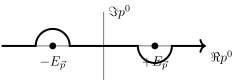
It turns out that there is a slightly more useful way of defining DD which is called the Feynman prescription. Rather than closing the contour above the real axis as in Figure 1, we have the contour weave between the poles as in Figure LABEL:fig:prop:feynman. The result is a mixture of the delayed and advanced Green’s functions

DF(xy)={D(xy)x0>y0D(yx)x0<y0=d4p(2π)41p2m2+iϵeip(xy)=θ(x0y0)0|ϕ^(x)ϕ^(y)|0+θ(y0x0)0|ϕ^(y)ϕ^(x)|00|T{ϕ^(x)ϕ^(y)}|0.\displaystyle\begin{split}D_{F}(x-y)&=\begin{cases}D(x-y)&x^{0}>y^{0}\\ D(y-x)&x^{0}<y^{0}\end{cases}=\int\frac{{\rm d}^{4}p}{(2\pi)^{4}}\frac{1}{p^{2% }-m^{2}+i\epsilon}{\rm e}^{-ip\cdot(x-y)}\\ &=\theta(x^{0}-y^{0})\langle{0}|\hat{\phi}(x)\hat{\phi}(y)|{0}\rangle+\theta(y% ^{0}-x^{0})\langle{0}|\hat{\phi}(y)\hat{\phi}(x)|{0}\rangle\equiv\langle{0}|T% \{\hat{\phi}(x)\hat{\phi}(y)\}|{0}\rangle\,.\end{split} (123)

In this Feynman propagator we ensure the order of events using the time-ordering symbol TT. We are required to place the last event on the left and the first event on the right. We will see soon why this is a good choice.
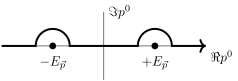
The complex plan for the energy component p0. Poles are at +Ep and -Ep. The integration contour mostly runs along the real axis, starting at minus infinity. It avoids to the poles by briefly swooping into the positive halfplane in a little arc centred around the pole.
Figure 1: The integration contour used for the delayed propagator DRD_{R}
The complex plan for the energy component p0. Poles are at +Ep and -Ep. The integration contour mostly runs along the real axis, starting at minus infinity. It avoids to the poles at -Ep by arcing above it into the positve halfplane and the one at -Ep by arcing into the negative halfplane.
Figure 2: The integration contour used for the Feynman propagator DFD_{F}